Leveraging Vietnamese Food Culture for Workplace Retention | Essential Knowledge for HR
Vietnam remains the largest source country of foreign workers in Japan, and hiring of Vietnamese talent continues across a wide range of industries, including manufacturing, construction, nursing care, and food processing. At the same time, workplaces continually report settlement challenges tied to meals—for example, “the cafeteria menu does not suit them,” “cooking in the dorm caused odor complaints,” or “nothing suitable was available on vegetarian observance days.”
Meals are not merely nutrition; they are deeply tied to cultural identity and religious practice. Whether Vietnamese talent feel they can “work here for the long term” depends heavily on the quality of food-life support at the workplace and in company housing. If accepting organizations overlook this point, they risk early turnover before employees clear the initial settlement barrier.
This article systematically covers the basics of Vietnamese food culture that hiring and HR professionals should know at minimum, how to identify religious dietary restrictions, concrete measures for the workplace and dormitories, and a practical framework for improving retention.
Basics of Vietnamese Food Culture: Understanding Common Ground and Differences with Japan
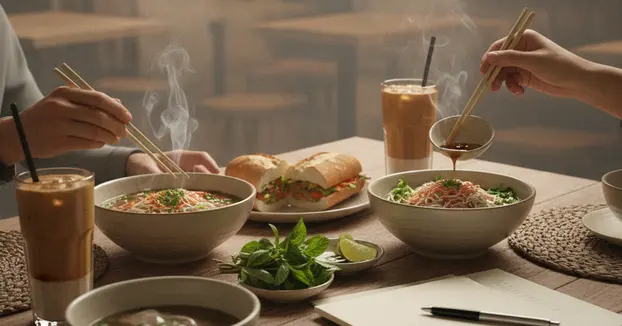
As in Japan, rice is the staple food in Vietnam. Pho (flat rice noodles), bun (thin rice vermicelli), and banh mi (French-style sandwiches) are also widely eaten, but a table centered on plain rice feels familiar to Japanese people as well. Sharing a rice-based foundation is a plus when designing company cafeteria menus.
One major difference is how seasonings and herbs are used. Vietnamese cooking relies on fish sauce called nước mắm. It is a fermented seasoning similar to Thai nam pla and has a distinctive fermented aroma. People accustomed to soy sauce and miso may find it intense, and it often causes odor issues in workplace break rooms and shared dorm kitchens.
Another hallmark is the culture of adding fresh herbs—cilantro (coriander), mint, lemongrass, green chili, and others—directly to dishes. These ingredients can be hard to find at ordinary Japanese supermarkets, so “how to source ingredients” becomes one of the bigger worries for Vietnamese talent in the early stage of settling into daily life.
Meal timing also matters. In Vietnam, the habit of eating breakfast early—around 6:00–7:00 a.m.—remains strong, and some people feel stress when sleep and wake rhythms shift to match workplace start times. Sharing meals with family and colleagues is also highly valued, so prolonged solitary eating tends to build a sense of isolation.
Regional differences should not be overlooked. The north (around Hanoi) often favors simple seasoning centered on saltiness and umami; the central region (around Hue) is spicier; and the south (around Ho Chi Minh City) adds sweetness and offers a wider range of ingredients. Hearing and recording each hire’s home region provides clues to food preferences and familiar flavors.
Vietnamese Dietary Restrictions Related to Religion and Custom
The most important factor in understanding dietary restrictions among Vietnamese talent is food practice based on religious background. Individual differences cannot be handled with a one-size-fits-all approach, so one-on-one interviews at the time of each hire are essential.
Buddhism and “ăn chay” (vegetarian/observance meals)
About 70–80% of Vietnam’s population is influenced by Buddhism (mainly Mahayana). The degree of practice varies by individual, but many people eat vegetarian observance meals (ăn chay) on the 1st and 15th days of the lunar calendar (twice a month). On those days they avoid meat, fish, eggs, and dairy, and eat meals centered on tofu, vegetables, mushrooms, and rice.
Where a company cafeteria exists, whether even one vegetable-centered option is available on observance days carries great meaning for employees with strong faith. Because observance days occur twice a month, that amounts to 24 days of consideration per year. Even if a perfect menu response is difficult, the simple fact that “a choice exists” builds trust in the workplace.
Catholic practices
Vietnam is one of Asia’s largest Catholic populations, with roughly 7–8% of the total population identified as Catholic. Some people avoid meat on Fridays during Lent, or fast around certain feast days. Around Easter and Christmas, participation in religious celebrations through meals may be important, so this should also be understood from a shift-scheduling perspective.
Support for Muslims (halal)
Muslim Vietnamese people, including Cham communities in southern and central Vietnam, also live in Japan. Full halal compliance is often difficult in a company cafeteria, but simply providing information on menus free of pork, pork-derived ingredients, and alcohol is already meaningful consideration. Even when numbers are small, overlooking this can seriously damage trust, so carefully interviewing about religious background at hiring is important.
Cultural differences around alcohol
In Vietnam there is a culture of enjoying beer and local drinks (such as bia hơi) at workplace gatherings, while others avoid alcohol for religious reasons. Pressuring people to drink at welcome/farewell parties or workplace events directly raises harassment risk, so the same careful consideration required for dietary restrictions is needed.
Practical Meal Support in the Workplace, Cafeteria, and Dormitory
Company cafeteria measures
For companies with a cafeteria, the following steps are effective for improving retention. Basic measures include adding rice-based Asian menu options several times a week; tracking the lunar calendar and offering at least one vegetable-centered menu on observance days (the 1st and 15th); posting allergen and ingredient information (whether pork, beef, or fish is used); and placing nước mắm or nam pla–style seasonings on the table.
These steps are not limited to Vietnamese employees; they improve the food environment for a multinational workplace overall. Framing them for leadership as “investment in a multicultural workplace,” rather than “special treatment for foreign nationals,” is an effective approach.
Improving cooking conditions in dormitories and company housing
Where company housing is provided, equipping the shared kitchen and putting usage rules in writing are essential. Odors from cooking with nước mắm and herbs easily create friction with Japanese residents. Posting ventilation and cleaning rules after use in both Japanese and Vietnamese is an effective way to encourage mutual understanding.
Cooking equipment also matters: steamers and large pots that are uncommon in typical Japanese homes may be needed. Providing a basic shared set of cookware suited to Asian cooking also helps raise residents’ satisfaction with daily life.
Providing ingredient-sourcing information
Simply giving written guidance at onboarding on access to Vietnamese grocery stores and supermarkets that carry Asian ingredients (nearest shops, hours, and public-transit routes) can greatly reduce anxiety in the early settlement period. Where stores are far—such as at regional factories—periodic group purchasing or support for online ordering are also options.
Common On-the-Ground Questions
In hiring-support practice, the following questions about meals for Vietnamese talent come up repeatedly. Below are judgment criteria and directions for response.
“Someone used nước mắm in the dorm kitchen and other residents complained.” Odor issues are among the most common consultations. Before banning use, first consider alternative rules such as “limited hours of use,” “mandatory range-hood ventilation,” and “use of sealed containers.” A total ban places a heavy psychological burden on Vietnamese talent and directly raises turnover risk.
“There was nothing they could eat in the cafeteria on a lunar observance day.” The first time may pass as “we didn’t know,” but from the second time onward trust is seriously damaged. Confirm at onboarding whether observance days are practiced, share an observance-day calendar with relevant departments, and secure at least minimal options (vegetable set meals, tofu dishes, egg-free menus, and the like).
“The cafeteria only serves Japanese and Western food, so every meal has become a convenience-store bento.” It may look fine in the short term, but rising eating-out costs and a growing sense of “no one is thinking about me” accumulate. Introducing an Asian menu even once a month, or ensuring rice can be chosen, already produces improvement.
“A Muslim staff member asked what they could eat in the cafeteria, and we could not answer.” As a starting criterion, confirm with the cafeteria contractor which menus contain no pork or pork-derived ingredients, list them, and post the information. Full halal certification is not required; beginning with information provision is realistic.
“After we warned them about cooking smells, they stopped speaking to us the next day.” Criticism or rejection of food culture can be received as an attack on identity itself. How feedback is given requires care; the basic approach is to communicate rules to everyone rather than singling someone out one-on-one.
Failure Patterns and How to Avoid Them
Below are failure patterns companies often fall into when supporting meals for Vietnamese talent, and how to avoid them.
Failure 1: Not interviewing about meal needs at hiring Dietary restrictions and cultural practices discovered only after joining lead to delayed responses that become direct causes of dissatisfaction and turnover. At the offer interview or pre-entry paperwork stage, build items such as “Do you have any religious dietary restrictions?” and “Do you have a monthly habit of avoiding certain ingredients?” into the interview sheet.
Failure 2: Assuming “they will be fine once they get used to Japanese food” They may appear to adapt in the short term, but mental and physical stress still accumulates. Forcing adaptation to Japanese food is received as a lack of cultural respect and steadily lowers workplace satisfaction. Shift from demanding adaptation to “providing choices.”
Failure 3: Over-regulating odor issues In cases where use of nước mắm and herbs was banned outright, Vietnamese talent who lost the enjoyment of home cooking left in succession. When imposing limits, always present alternatives as a set and build agreement with the people affected—that is the basic avoidance measure.
Failure 4: Treating observance days and religious meal practices as “personal preference” For Vietnamese people, vegetarian observance meals are faith, ancestral remembrance, and cultural practice itself. An attitude of “it’s just a food preference” damages long-term trust. Positioning respect for individual cultural practice as workplace culture directly improves retention of international talent.
The same importance of cultural consideration applies to international talent of nationalities other than Vietnam. For examples of communication and cultural-background consideration for Myanmar talent, see also our article on workplace communication with Myanmar talent.
Points Hiring Managers Often Overlook
In the day-to-day practice of hiring international talent, consideration for meals and daily habits is often undervalued. Yet these are among the root causes of turnover, and overlooking them directly wastes hiring costs for the company as well.
Pre-boarding lifestyle interviews have become a formality Many companies include a “religion” field on pre-boarding forms, but if the answer is “none,” they do not dig deeper. Buddhist vegetarian observance is often not consciously framed by Vietnamese people themselves as a “religious restriction,” so the question needs to become concrete: “Do you avoid certain ingredients once or twice a month?”
Checking dormitory cooking conditions is left until later Post-offer housing briefings tend to focus on floor plans and rent, while “types of cookware,” “ventilation conditions,” and “written shared rules” are often deferred. It is desirable to standardize a process of actually showing the shared kitchen and confirming conditions in person before the start date.
Japanese-language training does not cover how to communicate about food culture Business manners and workplace communication may be covered in Japanese training, yet “how to explain when meal rules differ” and “expressions for telling a supervisor about dietary restrictions” are sometimes missing. Revising training content to build two-way communication skills is effective.
Corporate response requirements related to meal and daily-life support for international talent are also addressed in the Ministry of Health, Labour and Welfare “Guidelines for Employers to Appropriately Deal with Improving Employment Management of Foreign Workers.” For living-support obligations by status of residence, confirmation against the public requirements of the Immigration Services Agency of Japan is recommended. Accepting organizations for Specified Skilled Worker status may need to file living-support plans through Hello Work or a Registered Support Organization, and procedure status can be managed via the e-Gov electronic application system.
Diagram: Pre-Hire Confirmation Flow (Meals and Daily Habits)
The following is a meal and daily-habit confirmation flow when hiring Vietnamese talent. We recommend embedding this flow as an internal standard so the same level of response is possible even when the person in charge changes.
STEP 1: Pre-offer interview (written or in person) Confirm four points: type of religion (Buddhism, Catholicism, Islam, or other); whether vegetarian observance meals (ăn chay) are practiced; food allergies or forbidden ingredients; and views on alcohol. Concrete questions such as “Do you avoid meat or fish on specific days each month?” work better than the abstract “Do you have a religion?”
STEP 2: Acceptance preparation (1–2 weeks before start) Complete four items: review cafeteria menus and organize what can and cannot be accommodated; prepare dorm cooking-equipment and rule explanation materials; collect information on nearby Asian grocery stores and online shops; and share the observance-day calendar (lunar 1st and 15th) with the cafeteria team.
STEP 3: Onboarding day Carry out three points: explain cafeteria and break-room rules (Vietnamese materials are even better); confirm shared kitchen rules (communicate to all residents); and introduce the SOS contact for meal-related issues (clarify who to contact and how).
STEP 4: Post-hire follow-up (1 month, 3 months, 6 months) In regular one-on-ones, ask about meal and daily-life difficulties and check how observance-day support is working in practice. Connect findings to cafeteria menu or dorm-equipment improvements as needed.
Standardizing this flow enables consistent meal and daily-life support across the organization, without depending on each coordinator’s judgment criteria or experience.
Practical Checklist
A practical checklist on meal and daily-habit support for hiring and acceptance staff. Use it as a reference before and after the target staff member joins.
- ☐ Religion and dietary restrictions (vegetarian observance, halal, etc.) are confirmed in concrete terms at the hiring interview
- ☐ Staff are asked explicitly whether they have a habit of avoiding certain ingredients once a month or more
- ☐ The cafeteria weekly menu includes rice-based or Asian options
- ☐ At least one vegetable-centered menu can be provided on lunar observance days (1st and 15th each month)
- ☐ Ingredient-use information (presence of pork, beef, fish, or alcohol) is posted in the cafeteria
- ☐ Shared kitchen rules in the dorm are posted in Japanese and Vietnamese
- ☐ Information on nearby Asian grocery stores and online shops is included in onboarding documents
- ☐ The meal-related consultation contact (name and details) is communicated to all staff
- ☐ Response procedures are documented for when odor complaints or similar issues arise
- ☐ Follow-up interviews at 1, 3, and 6 months after joining check meal and daily-life difficulties
Frequently Asked Questions (FAQ)
Q. Is meal-related support still needed in workplaces without a cafeteria where people bring their own lunch?
A. Yes. Even in bring-your-own-lunch workplaces, you need refrigerators, microwaves, and hot-water facilities; adequate meal space; and tolerant rules around odors when reheating food. Also consider cases where people need to go out after hours to buy ingredients.
Q. We asked the cafeteria contractor to handle observance days and were told they “cannot accommodate.” What should we do?
A. First discuss with the contractor whether existing menus can be adapted (tofu set meals, stir-fried vegetable set meals, and so on). If that is difficult, a realistic option is to allow packed lunches on observance days and ensure reheating facilities. More than perfect accommodation, the stance of being “a workplace with choices and consideration” itself builds employee trust.
Q. We have staff who need Muslim (halal) support. Where should we consult?
A. The Japan Halal Association and local mosques have consultation channels. In living-support plans for Specified Skilled Worker and Technical Intern Training, a Registered Support Organization may also be able to assist with religious meal accommodation. Please start by contacting us through Foreign Talent Insights.
Q. To prevent odor issues, we want to restrict use of certain ingredients. Is that a problem?
A. Setting reasonable kitchen-use rules in work rules or dorm rules is not itself a problem. However, restrictions that single out ingredients linked only to a particular ethnicity or religion may raise issues under reasonable accommodation duties and discriminatory treatment. Design them as “rules that apply to everyone,” and when odor limits exist, always pair them with alternatives such as ventilation requirements or limited hours of use.
Q. Is meal support for Vietnamese talent included in the Specified Skilled Worker “support plan”?
A. Under the Specified Skilled Worker system, Registered Support Organization support plans include an obligation to provide information necessary for daily life, and guidance on ingredient sourcing and the meal environment is positioned as part of that. Refer to the latest guidelines from the Immigration Services Agency of Japan for system details.
---
Understanding the food culture of Vietnamese talent and putting lifestyle support in place at the workplace and in dormitories is a practical investment that directly contributes to both recovering recruitment costs and long-term retention. For a foundational understanding of the systems and procedures for hiring international talent, please also see our basic article on hiring foreign workers.
Companies that would like individual consultation on building support systems for daily living culture are encouraged to contact us via inquiries to Foreign Talent Insights. Our specialist team supports you from diagnosing the current state of your acceptance framework through to improvement proposals.
---
*Supervised by: Foreign Talent Insights Editorial Team*
Related Articles: Practical Topics Worth Reviewing Together
Please also review practical articles on related themes as needed.
- Vietnamese Daily Life Culture and Workplace Retention | A Practical Guide HR Professionals Should Know
- Vietnamese Talent’s Family Values and Their Relationship to Work — A Practical Hiring Guide to Improve Workplace Retention
- Characteristics of Vietnamese Cuisine and Food Culture | What to Know Before Working with Vietnamese Staff
 Written by
Share this article


