ACCEPTANCE & EDUCATION
Don’t Risk Offense: Food Restrictions Among Nepali Workers—Foods to Avoid by Religion
Quick answer: What is the religious makeup of Nepal?
About 81% of Nepal’s population is Hindu, followed by roughly 9% Buddhist and about 4% Muslim. People who practice Kirat and Christianity also live there, and diverse religious values coexist within one country. Even among people from Nepal, what someone can eat differs by faith and family custom, so the surest approach at work is to ask the person directly.
As more companies welcome Nepali employees, consideration around meals is a first step in building trust. Nepal is a country where multiple religions—including Hinduism, Buddhism, and Islam—coexist, and what people cannot eat differs greatly by religion. Serving a food regarded as taboo without realizing it can deeply hurt the person. This article explains food restrictions among Nepali people by religion and practical points for meal consideration in the workplace.
Understanding Nepali meals ①: Religious context you should know
To understand Nepali meals correctly, you first need to know Nepal’s religious landscape. In Japan, people rarely think about the link between religion and food in daily life, so this is an easy point to overlook.
Nepal is a multi-religious country
About 81% of Nepal’s population is Hindu, followed by roughly 9% Buddhist and about 4% Muslim. People who practice Kirat and Christianity also live there, and diverse religious values coexist within one country. For more basic information on Nepal, see also “Basic facts about Nepal to know before hiring Nepali talent.”
For that reason, you cannot speak about food tendencies by lumping “Nepali people” into one group. Even among people from the same country, what they can and cannot eat often differs completely depending on their religion and family customs. It is important to start from an understanding of this diversity.
The link between religion and food is stricter than in Japan
In Japan, Buddhist influence has produced a culture of shojin (vegetarian temple) cuisine, but few people consciously observe religious food restrictions in everyday life. In Nepal, by contrast, religious dietary rules are deeply rooted in daily eating habits.
For example, for Hindus the cow is sacred, and eating beef is a religious taboo. This is not a mere “preference” or “habit,” but a strict rule grounded in faith. Approaching it with a Japanese mindset of “a little should be fine” can come across as dismissing the other person’s beliefs. There is some overlap with religious issues in Vietnam, but it is better to assume Nepal has its own particular strictness. The relationship between religion and food in Vietnam is covered in “Religion in Vietnam: Taboos, daily customs, and more.”
By religion ②: A guide to foods Nepali people may not eat
Below we outline, for each major religion in Nepal, foods to avoid and ingredients that require care. Use this as a practical reference when arranging meals at work.
For Hindus, beef is taboo
For Hindus, who make up about 81% of Nepali people, the most important food restriction is the taboo on beef. The cow is regarded as a sacred animal in Hinduism, and eating beef is a strong taboo. That said, in Nepal “cow” and “water buffalo (buff)” are clearly distinguished, and it is useful to know that many Hindus eat water buffalo meat in daily life.
What matters is that the restriction is not limited to beef itself. Processed foods that use beef extract, gelatin (from cattle), or beef tallow must also be avoided. Consommé and bouillon commonly used in Japan often contain beef-derived ingredients, and curry roux and instant soups frequently do as well. In addition, some devout Hindus avoid meat entirely and practice vegetarianism. When serving meals, checking ingredient labels provides peace of mind.
For Muslims, pork and alcohol are taboo
Muslims make up about 4% of Nepal’s population, but it is entirely possible to have Muslim Nepali colleagues at work. In Islam, eating pork is strictly forbidden, and alcohol is also taboo.
For pork, foods containing lard or pork-derived gelatin are also covered. Japanese sweets, bread, and some seasonings may use lard or gelatin, so checking ingredient labels is essential. In addition, basic Japanese seasonings such as mirin and cooking sake contain alcohol, and strict Muslims tend to avoid these as well. Choosing foods with halal certification is the most reliable approach.
Buddhists often tend to avoid meat in general
Nepali Buddhists tend to refrain from meat in general, based on teachings that discourage taking life. That said, dietary restrictions in Buddhism are not as strict as in Hinduism or Islam, and in practice the degree of observance varies widely by individual and household.
Some people maintain full vegetarianism, while others eat chicken or fish. It is also useful to know that some avoid meat only during certain religious observances or festival periods. Even so, it is wrong to assume that “Buddhists will eat meat.” Asking the person directly is the best approach.
Foods Nepali people enjoy ③: Staple dishes and how to recreate them in Japan
Beyond restrictions, knowing what dishes Nepali people like helps you convey a welcome more effectively. Here we introduce staple Nepali dishes and meal ideas that are easy to adopt in Japan. For a broader picture of Nepali food culture, see also “Nepali food culture and dining manners useful for employing foreign staff.”
Dal bhat is the national dish eaten every day
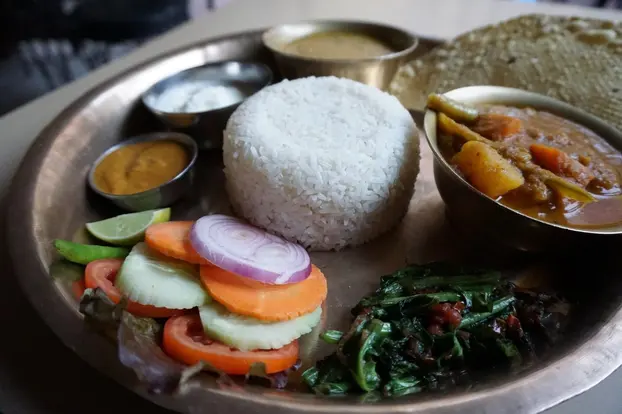
Essential to the Nepali table is “dal bhat.” Centered on dal (lentil soup) and bhat (rice), it is a set-meal style dish combined with vegetable sides and achar (pickles and condiments), and many Nepali people eat it almost every day.
It is fair to think of it as what plain rice and miso soup are to Japanese people—the “taste of home” for Nepali people. Lentil soup is nutritious and acceptable across religions, so it is one of the most reassuring menu options when preparing meals for Nepali colleagues.
Spice-forward dishes are popular
A major feature of Nepali cuisine is the generous use of spices such as cumin, turmeric, and coriander. Unlike the delicate seasoning of Japanese food, many people prefer aromatic dishes with a clear, robust flavor.
For that reason, among Japanese dishes, curry rice is especially popular. Noodle dishes such as yakisoba and udon are also easy to adapt with spices and seasonings, and we often hear that they are well received. Including such options in the company cafeteria or at lunch is likely to be appreciated.
You can recreate dishes with ingredients available in Japan
Nepali cooking can be recreated to a fair degree with ingredients available at Japanese supermarkets, without special products. For example, red lentils can be bought at import food stores or online shops, and simply simmering them produces the basics of dal.
Basic spices such as cumin powder and turmeric are also increasingly common in the seasoning aisle of ordinary supermarkets. In addition, specialty shops carrying Nepali ingredients and halal shops are growing, especially in urban areas. You do not need a perfect recreation—the very effort to “get closer to Nepali flavors” is likely to mean a great deal to Nepali employees.
What to watch in workplace meal settings ④: Manners and consideration
Considering not only what is served but also manners and cultural habits around meals will further deepen trust with Nepali employees. Here we cover points that are especially worth keeping in mind at work.
For welcome parties and social gatherings, confirm food restrictions in advance
When inviting Nepali employees to a welcome party or social gathering, confirming food restrictions in advance is essential. It can and does happen that an organizer books a yakiniku restaurant or izakaya without checking, and on the day the person finds almost nothing they can eat.
Simply asking “Is there anything you cannot eat?” before choosing a restaurant can prevent such problems. We recommend restaurants with solid vegetarian menus or venues flexible about allergies and religious needs. Not pressuring people to drink alcohol at after-work gatherings is also basic manners. For more on consideration around religion and meals, see “Consideration for religious faith and meals.”
Be careful about left-hand use and sharing dishes
In Nepali culture, the left hand is considered unclean, and there is a custom of avoiding handling food with the left hand at meals. Many people also feel uncomfortable sharing dishes with others or serving food onto someone else’s plate with their own chopsticks.
In Japanese meal settings, however, people often share large platters or gather around a hot pot. In those situations, small steps such as providing serving chopsticks or spoons are effective. Responding naturally with cultural background in mind helps protect the other person’s dignity.
A simple “Can you eat this?” builds trust
What matters most in meal consideration is not special preparation or cost, but the attitude of checking. Simply asking “Can you eat this?” or “Is there any food you avoid?” should make Nepali employees feel that their culture is being respected.
That said, you do not need detailed questions at every meal. If you confirm carefully once at the start, you can handle things smoothly afterward. Meal consideration is one of the easiest entry points into cross-cultural understanding. These small accumulations help grow trust across the workplace.
Summary
Food restrictions among Nepali people differ greatly by religion—such as the Hindu taboo on beef and the Muslim taboos on pork and alcohol. Attention is also needed for easy-to-miss ingredients such as gelatin, consommé, and mirin. At the same time, staple Nepali dishes such as dal bhat are relatively easy to recreate in Japan, and food can be a strong way to deepen communication.
What matters is not mastering everything perfectly, but respecting the other person’s food culture and faith and having an attitude of checking. Small consideration that begins with “Can you eat this?” becomes a major step in building trust with Nepali employees. Understanding and meeting halfway in everyday meal settings should make cross-cultural coexistence at work richer.
FAQ: Religion and food in Nepal
What is the most common religion in Nepal? Hinduism. About 81% of the population is Hindu, followed by roughly 9% Buddhist and about 4% Muslim. People who practice Kirat and Christianity also live there, making it a multi-religious country where diverse religious values coexist. How does religion affect food in Nepal? In Japan, few people consciously observe religious food restrictions in daily life, but in Nepal religious dietary rules are deeply rooted in everyday eating. For example, for Hindus the cow is sacred, and eating beef is a religious taboo—not a mere preference or habit, but a strict rule grounded in faith. What can Hindu Nepali people not eat? The most important restriction is the taboo on beef. Beyond beef itself, processed foods using beef extract, cattle-derived gelatin, or beef tallow must also be avoided. Consommé, bouillon, curry roux, and instant soups commonly used in Japan often contain beef-derived ingredients. Note that in Nepal “cow” and “water buffalo (buff)” are clearly distinguished, and many Hindus eat water buffalo meat in daily life. What consideration is needed for Muslim and Buddhist Nepali people? Muslims, about 4% of the population, treat pork and alcohol as taboo, and care is also needed with lard, pork-derived gelatin, mirin, and cooking sake. Choosing halal-certified foods is the most reliable approach. Buddhists tend to refrain from meat in general based on teachings against taking life, but the degree of practice varies widely by individual and household, so asking the person directly is best. How far should you check for welcome parties and the company cafeteria? Simply asking “Is there anything you cannot eat?” before choosing a restaurant can prevent the problem of having nothing to eat on the day. Choose restaurants with solid vegetarian menus or venues flexible about allergies and religious needs, and do not pressure people to drink alcohol at gatherings—these are basic manners. You do not need detailed questions every time; if you confirm carefully once at the start, you can handle things smoothly afterward.
 Written by
Share this article


