Guide to Dormitory Life Considerations for Myanmar Talent | Practical Briefing for HR and General Affairs
More companies are moving to hire Myanmar talent, yet HR and general affairs staff keep reporting the same concerns: “Trouble arose in dormitory life after hiring” and “We don’t know what standards to use for accommodations.” Many Myanmar workers who come to Japan through the Specified Skilled Worker or Technical Intern Training systems start out in company-provided employee dormitories right after joining. Whether talent who arrive unfamiliar with both Japanese and daily life in Japan can perform at their best at work depends heavily on whether the dormitory—the foundation of daily living—feels safe and usable.
This article organizes Myanmar’s religion, food culture, daily customs, and cultural background, then explains in concrete terms the issues HR staff often face in practice and how to address them. It also includes an FAQ based on common on-site consultations and a practical checklist. Use it to build a consistent acceptance framework from pre-hire preparation through regular follow-up after move-in.
Why Myanmar talent is rising fast—and why dormitory acceptance is strategically important
According to statistics on foreign residents from the Ministry of Justice’s Immigration Services Agency of Japan, the number of Myanmar nationals residing in Japan has grown rapidly in recent years, and their presence has strengthened among Southeast Asian nationals under both the Specified Skilled Worker and Technical Intern Training systems. Myanmar talent is increasingly active in manufacturing, food processing, construction, nursing care, and other workplaces facing severe labor shortages, and hiring demand is expected to keep rising.
Against that backdrop, the employee dormitories companies prepare when accepting foreign workers have become a strategic asset beyond mere “housing provision.” When the dorm living environment is in good order, anxiety right after arrival eases and early turnover risk falls. Conversely, if religious or dietary needs are overlooked, or if living rules are poorly explained, mismatch surfaces within only a few months of joining—often for the reason that “this is not the environment we expected.”
The basic framework for hiring foreign nationals overall is covered in detail in our foundational article on hiring foreign nationals; this article narrows in on cultural and religious background specific to Myanmar talent and offers more hands-on information.
Understand Myanmar’s religion and food culture accurately
Myanmar is a multiethnic country, and religious backgrounds are not uniform. Below is a summary of the main religious composition HR should grasp before hiring, and how each affects daily habits.
Theravada Buddhism
About 87% of the population practices Theravada Buddhism. Its precepts differ from Japanese Mahayana Buddhism, and devotees who keep the precepts strictly may avoid beef (cows are culturally regarded as sacred beings that help with farming). Many men have monastic experience, and some make morning offerings to active alms-collecting monks (pongyi) a daily habit. Many staff know Myanmar mainly through coverage of the Rohingya issue, but the large majority of Myanmar talent working in Japan are Buddhist, and most religious practice is mild in nature.
Christianity (including Kachin, Karen, and Chin peoples)
About 6% of the population practices Christianity (Protestant and Catholic), more often among talent from ethnic minorities. Dietary restrictions are almost nonexistent, but many value Sunday worship, so shift flexibility is helpful.
Islam
About 4% of the population practices Islam. Pork and foods containing pork-derived ingredients are forbidden (haram), so dormitory cafeteria menus and shared cooking utensils need review. During Ramadan (the fasting month), follow-up on shifts and health management is also needed, given that daytime meals cannot be taken.
Points common across food culture overall
Regardless of religion, the following food traits are common among Myanmar talent in general.
- The staple is white rice; many people find a bread-only breakfast unsatisfying
- Cooking culture makes heavy use of fish sauce, shrimp paste (ngapi), and chili
- Having grown up on sweet-savory fermented foods, many are initially unsettled by Japan’s lighter seasoning
- Demand is high to cook for themselves using seasonings and ingredients they bring
When the dorm has a shared kitchen, clearly stating shared-management rules for cooking oil, pots, and cutting boards directly helps prevent friction with other residents (Japanese and other nationalities).
Common on-site consultations: gaps in daily habits and communication
Among common on-site consultations, HR and dorm managers repeatedly raise cases like the following.
“Japanese residents complain that they gather with friends and make noise late at night”
In Myanmar it is customary to spend long stretches eating and talking with friends and colleagues, and “gathering” itself is closely tied to emotional stability. This is one setting where friction easily arises with Japanese residents who treat nighttime noise as a problem. Simply writing “rules for using shared spaces after lights-out” into the move-in guidelines and explaining them in Myanmar language at move-in resolves most cases.
“They remove shoes before entering the room, but leave shoes scattered in the hallway”
Removing shoes at the entrance is also practiced in Myanmar, but it differs from the Japanese custom of lining them up neatly. Explaining how to use the shoe rack and the reason—“so you don’t block other people’s path”—with photos speeds understanding.
“They said ‘I’m fine,’ but were actually struggling”
In Myanmar culture there is a tendency to avoid saying “no” directly to others (especially those in a higher position). This indirect communication style is covered in detail in our article on workplace communication with Myanmar talent, and the same issue arises in dorm life. Rather than confirming problems with yes/no questions, ask with concrete examples—“Is anything troubling you right now? For example, meals or your room?”—and genuine concerns come out more easily.
“They didn’t know how to use the washing machine and kept hand-washing”
Japanese washing machines have complex control panels, and many people say they cannot figure out how to use them without guidance in Myanmar language. Posting simple operating steps in Myanmar (Burmese) alone greatly raises residents’ quality of life.
Failure patterns and how to avoid them: what companies that stumble on dorm operations have in common
Knowing failure patterns and avoidance measures is the most practical learning when designing an acceptance framework. Representative patterns are below.
Failure pattern 1: Distributing move-in rules in Japanese only
Handing a Japanese-only dorm handbook to Myanmar talent whose Japanese at hire is around JLPT N4–N5 does not convey the content adequately. A state of “not knowing the rules” continues, and when they later become subject to warnings or penalties, they feel “Why was I suddenly scolded?” and distrust grows.
Avoidance measure: Prepare a Myanmar-language living guide and also confirm the content orally at move-in. Google Translate quality improves year by year, and for living-rule documents with little specialized terminology you can get practical translations. When more accurate translation is needed, Myanmar-language translation services or help from senior Myanmar talent already on staff are also effective.
Failure pattern 2: Serving pork dishes every day without changing the cafeteria menu
When Muslim Myanmar talent move into a dorm, menus that use pork every day leave them able to eat almost nothing, forcing them to keep buying convenience-store food or eating out at their own expense. That is not only a financial burden; it also creates the impression that “the company is not thinking about us.”
Avoidance measure: Interview on religion and dietary restrictions before hiring, and consider flexible responses—for example, beef-free menus if the group is mostly Buddhist, or pork-free menus on several days a week if Muslims are present. If changing menus for everyone is difficult, preparing an environment where people can cook for themselves is the next-best option.
Failure pattern 3: Clustering Myanmar talent too heavily in the same rooms
Out of consideration that “people from the same country will feel more at ease,” some companies concentrate Myanmar talent in the same rooms or on the same floor, but this invites community isolation at work. Opportunities to speak Japanese decline, and interaction with Japanese employees is less likely to form. Friction can also arise among people of the same nationality because of ethnic and religious differences within Myanmar.
Avoidance measure: Decide room assignments considering not only nationality but also job type, shift, gender, and religious background. It is important to confirm roommate relationships in regular post-move-in interviews and keep flexibility to consider room changes when needed.
Failure pattern 4: Skipping explanation of garbage-sorting rules
Myanmar does not generally have Japan’s detailed garbage-sorting system. Being told “you are not sorting properly” without explanation does not convey what the problem is. Creating a sheet that summarizes the municipality’s sorting rules in Myanmar language and handing it over at move-in also helps prevent trouble with local residents.
Points hiring managers often miss: concrete cultural accommodations
Among points hiring managers often miss, institutional items (status of residence, employment contracts, social insurance) may be in place while cultural accommodations are left for later. Confirm the following in advance as a preparation list.
Space and time for worship and faith practice
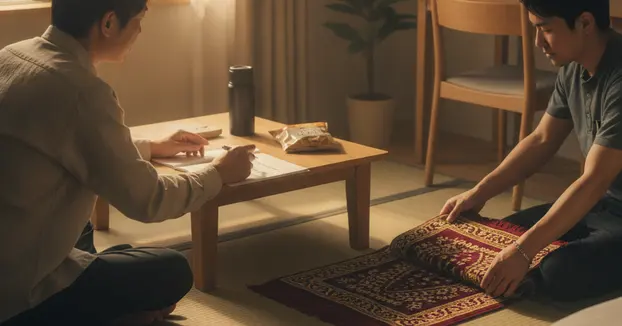
Many Buddhist Myanmar workers have a habit of putting their hands together before a small Buddhist altar or photo in the morning or evening. Securing a small space for that in a private dorm room is easy, but without an explicit rule on “whether religious items may be kept in the room,” people hold back. Simply stating that “personal faith practice inside private rooms is free” greatly changes their sense of security.
Consideration for the Myanmar calendar and Buddhist observances each month
Myanmar has its own religious events and holidays. Representative ones include the following.
- Thingyan (Water Festival): mid-April. The largest festival, equivalent to Myanmar New Year. A period when wishes to return home or travel tend to surface.
- Thadingyut (Festival of Lights): around October (varies by the Buddhist calendar). The day the rains retreat ends; an observance of gratitude to family and the Buddha.
- Tazaungdaing: around November. A festival aligned with the full moon of the month following the Festival of Lights.
Reflecting in the annual plan that paid leave and home-return requests tend to concentrate in these periods makes on-site shift adjustment smoother. Promoting annual paid leave also aligns with the spirit of the guidelines on employment management of foreign workers issued by the Ministry of Health, Labour and Welfare.
Consideration for how names and nicknames are used
Myanmar names are often hard for Japanese speakers to pronounce, and at work they are sometimes shortened or altered without consent. Confirming at hire that the person can choose a nickname that is easy to say in Japanese is effective for psychological safety. Name structure and cultural meaning are also explained in detail in our article on workplace communication with Myanmar talent.
Support for access to daily-life infrastructure
Opening a bank account, contracting a smartphone, and using international remittance services are the most difficult practical issues for Myanmar talent right after arrival. For Specified Skilled Worker status, companies or Registered Support Organizations are obligated to provide support as part of the support plan; even under Technical Intern Training, companies that offer similar support have an edge on retention. For details on status of residence procedures, also see our explanation of status of residence for highly skilled foreign professionals.
Organizing the laws and guidelines that serve as decision criteria
The following organizes laws and guidelines that serve as decision criteria when designing dormitory accommodations.
Guidelines on improving employment management of foreign workers (Ministry of Health, Labour and Welfare)
The Ministry of Health, Labour and Welfare’s “Guidelines for employers to deal appropriately with improvement of employment management, etc. of foreign workers” expressly list support for securing housing, consideration for culture and customs, and establishment of consultation systems as employers’ duties of effort. These guidelines do not carry penalties, but they can form a basis for administrative guidance, so accepting companies should at minimum meet their substance.
Support plans under the Specified Skilled Worker system (Immigration Services Agency of Japan)
Companies that accept Specified Skilled Worker foreign nationals are obligated to formulate and implement a “Support Plan for Specified Skilled Worker (i) Foreign Nationals” set by the Immigration Services Agency of Japan. That plan includes “living orientation,” “support for securing housing,” and “consultation on daily life,” all of which link directly to living accommodations in the dorm. It is important to keep concrete implementation records grounded in actual dorm life so the support plan does not remain a formality.
Relationship to the Labor Standards Act and the Minimum Wage Act
When deducting dormitory fees from wages, a labor-management agreement under Article 24 of the Labor Standards Act is required, along with confirmation that pay does not fall below the minimum wage. For caps on deduction amounts and calculation methods, consulting the local Hello Work (Public Employment Security Office) or Labor Standards Inspection Office is recommended.
Diagram: Pre-hire confirmation flow (text version)
Below is a stage-by-stage confirmation flow for accepting Myanmar talent into a dormitory.
Step 1: During hiring selection (before offer)
- Conduct interviews on religion and dietary restrictions
- Confirm dorm facilities (kitchen, washing machine, space for religious practice)
- Grasp the nationality and religious composition of other residents
Step 2: From offer through before arrival in Japan
- Translate the dorm handbook and living-rules documents into Myanmar language
- Prepare a packing list for move-in (in Burmese)
- For Specified Skilled Worker: record dormitory accommodation items in the support plan
Step 3: Immediately after arrival in Japan (move-in orientation)
- Oral explanation of dorm rules and how to operate facilities (use an interpreter or translation app)
- Communicate garbage sorting, noise, and shared-space use rules
- Provide emergency contacts and consultation channels
Step 4: After move-in (regular follow-up)
- Hold individual interviews at the 1-month, 3-month, and 6-month marks after move-in
- Check for roommate issues and requests
- Check satisfaction with meals and living environment
Practical checklist: Dormitory acceptance preparation and operations management
As a practical checklist, please confirm the following items before acceptance.
Pre-acceptance preparation
- Residents’ religion and dietary restrictions have been interviewed at the hiring stage
- A Myanmar language (Burmese) version of the dormitory handbook is available
- The cafeteria menu includes options that account for religious dietary restrictions, or self-cooking facilities are in place
- Shared kitchen usage rules (including restrictions on shared cooking utensils, etc.) are clearly stated
- Instruction manuals for washing machines, cooking appliances, etc. are prepared in Myanmar language
- Materials explaining waste sorting rules in Myanmar language are available
- The rules clearly state that religious practice inside private rooms is permitted
- For Specified Skilled Worker status, the support plan specifically describes living support content in the dormitory
- If dormitory fees are deducted from wages, a labor-management agreement has been concluded and minimum wage compliance has been confirmed
Post move-in operations
- Individual interviews were conducted within one month of move-in
- Relationships with roommates and any difficulties were checked
- Consideration to make paid leave easier to take during religious events (such as Thingyan) has been reflected in the annual plan
- Contact information for the consultation desk (native language support available) has been communicated
- A system for regular surveys or interviews regarding dormitory life is in place
For strengthening your acceptance framework or designing specific support content, you can also consult us via the Foreign Talent Insights contact page.
Frequently asked questions (FAQ)
Q1. Is it true that not all Myanmar talent avoid beef?
A. More accurately, many people do not eat it, but not everyone. Strict Buddhists and those from rural areas tend to avoid beef, but younger people from urban areas often have no particular restrictions. Individual interviews at the hiring stage are the most reliable approach.
Q2. Do we need to set up a separate prayer space in the dormitory?
A. There is no legal obligation. However, if there are multiple Muslim Myanmar talent, securing one clean room for prayer will be appreciated. For Buddhists, practice inside private rooms is sufficient in most cases.
Q3. How can we prevent dormitory troubles among Myanmar talent?
A. Myanmar has 135 ethnic minorities, and relationship issues can arise from differences in ethnicity, religion, and region of origin. Considering place of origin, ethnicity, and religion when assigning rooms, and regularly checking interpersonal relationships through post move-in interviews, are effective preventive measures.
Q4. Is cultural consideration in dormitories mandatory for statuses other than Specified Skilled Worker (Technical Intern Training and general employment)?
A. Unlike Specified Skilled Worker status, there is no legally codified support obligation for Technical Intern Training or general employment, but the Ministry of Health, Labour and Welfare’s guidelines on employment management of foreign workers apply regardless of status of residence. Moreover, cultural consideration directly contributes to preventing turnover and improving retention, so we recommend implementing it whether required by the system or optional.
Q5. Who should we ask to translate into Myanmar language?
A. For everyday living rules documents, Google Translate or DeepL can provide practical quality. For documents requiring legal effect (such as notices of working conditions), we recommend using a professional translation service that handles Myanmar language, or asking Myanmar talent within your company to review.
---
Considerations for Myanmar talent dormitory life involve almost no ongoing cost once systems are in place. By combining the practical checklist and failure patterns and avoidance measures introduced in this article, centered on the three pillars of preparing translated documents, meal considerations, and regular interviews, you can substantially reduce early turnover at the 3-month and 6-month marks after joining. Retention after hiring is the greatest ROI in utilizing international talent. For consultations on designing or reviewing your acceptance framework, feel free to contact Foreign Talent Insights.
---
*Written and supervised by: Hayato Yamashita (tokutei_gino_practical_editor) / Last updated: June 2026*
Related articles: Practical topics to review together
Please also review practical articles on related themes as needed.
 Written by

ヤマシタハヤト
Share this article


