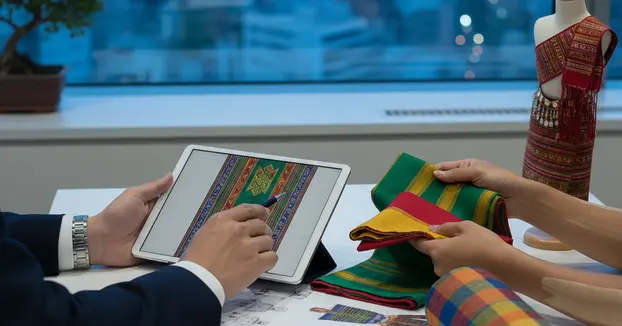
What Is Myanmar’s Traditional Costume (Longyi)? Types, Gender Differences, Dress of 135 Ethnic Groups, and Workplace Cultural Considerations
When a staff member from Myanmar asks, “May I come to work in a longyi?”, are you prepared to answer appropriately? Myanmar’s ethnic dress is still unfamiliar to many Japanese companies, yet in Myanmar it is worn daily by people of all ages and genders and also plays a central role on formal and ceremonial occasions.
According to the latest statistics from the Immigration Services Agency of Japan, the number of Myanmar nationals residing in Japan exceeded about 75,000 as of the end of 2023, and their presence as Specified Skilled Worker talent is rising rapidly in fields such as manufacturing, nursing care, and food service. Accurately understanding their cultural background directly supports better workplace environments and stronger working relationships.
This article systematically explains Myanmar’s representative ethnic costume, the longyi—from the basics, through the dress characteristics of each of the 135 recognized ethnic groups, formal-wear customs at festivals, and practical points of workplace consideration. It offers knowledge that hiring and HR managers considering Myanmar talent can put to use on the ground right away.
---
What Is the Longyi, Myanmar’s Representative Ethnic Costume?
The “longyi” is a tubular cloth worn daily throughout Myanmar. It is a skirt-like garment wrapped from the waist to the ankles, and materials range widely from cotton and silk to synthetic fibers.
The longyi’s origins go back to garments of the same lineage as the “sarong” found across Southeast Asia. In Myanmar it is said to have become widespread from around the 16th century, and today it remains established as everyday wear in government offices, schools, and homes alike. Thinking of it as comparable to the yukata or samue in Japanese traditional dress culture makes it easier for receiving employers to picture.
Longyi Materials and Formality Levels
Longyis have two formality levels depending on use.
- Everyday wear: Mainly cotton. Light and easy to care for, and worn for farm work and housework as well. Everyday workplace wear is often this type
- Formal wear: Uses silk (especially a silk textile called “acheik”). Worn for weddings, festivals, and official occasions. Pieces with gold thread or embroidery have craft-like value
Traditional weaving techniques differ by region, and high-quality longyis circulate in Myanmar and abroad as representative handicrafts. When you see someone in a formal longyi, understand that they are likely attending an important occasion for them.
---
Men’s and Women’s Longyi Types and How They Are Worn
Men’s Longyi: Paso
The men’s longyi is called a “paso.” It generally uses checked or striped cloth, twisted up at the front of the waist into a band-like finish and tied at the center front.
Key points for wearing a paso:
- For formal dress, choose plain or finely checked silk
- Finish it at the front in a form called “meut”
- Pair it with a white shirt or a traditional stand-collar jacket called an “eingyi”
- Bare feet with sandals are common, though leather shoes may be worn for ceremonies
Note that retying a loosened longyi in public while walking is routinely accepted. There is no need to take this as “sloppy.”
Women’s Longyi: Htamein
The women’s longyi is called a “htamein” and differs structurally from the paso. The cloth is wrapped around the waist, folded in at the side and secured, and the length reaches the ankles.
Features of the htamein:
- Richer in color than the paso, often with floral or geometric patterns
- A black band-like cloth called an “ahpyo” is often sewn onto the lower edge
- A blouse (eingyi) is basically worn on the upper body
- For formal dress, high-quality silk with embroidery or gold thread is used
Formal Upper Garment: Eingyi
The eingyi is a stand-collar shirt or jacket worn by both men and women. Everyday versions use lightweight cotton, while formal versions use lace or silk.
- Men’s: Simple designs in white or light colors are standard
- Women’s: Sheer lace is often used for formal wear, and embroidery is also common
At official events, the longyi-plus-eingyi combination is recognized as standard formal wear in Myanmar. Understand it as formal dress equivalent to a suit in Japan.
---
Diversity of Dress Among Myanmar’s 135 Ethnic Groups
According to the Ministry of Foreign Affairs’ “Basic Data on Myanmar,” the Myanmar government recognizes “135 national races (taingyintha)” in the country, classified into eight major ethnic groups. Each group has its own dress culture, and ethnic-specific costumes are worn especially at festivals and life-cycle ceremonies.
Myanmar talent living in Japan come from diverse ethnic backgrounds, so a simple equation of “Myanmar person = longyi” is not enough. Below we outline the dress features of the major ethnic groups.
Bamar (Burman)
- Population share: The majority ethnic group, about 68% of Myanmar’s total population
- Dress features: The longyi (paso/htamein) is basic. This is the most common style, and many Myanmar people in Japan are of Bamar origin or belong to the urban Bamar cultural sphere
- Workplace impact: Because the longyi is used as everyday wear, it is important to state clearly at the hiring stage whether longyi may be worn at work
Shan
- Population share: About 9%. Mainly resident in Shan State
- Dress features: A set of loose trousers and jacket called a “Shan outfit.” Men wear wide trousers with a jacket; women often wear a one-piece style with embroidery at the hem
- Notes: Shan handwoven cloth is a craft highly regarded internationally, known for rich colors and geometric patterns
Karen (Kayin)
- Population share: About 7%. Resident in Kayin State, Tanintharyi Region, and elsewhere
- Dress features: A representative upper garment called “thee-dah,” white with red vertical stripes. Characterized by abundant embroidery and flowing use of cloth
- Workplace impact: Karen people often have a strong identity tied to ethnic dress and may wish to wear formal dress around “Karen New Year (January)”
Kachin
- Population share: About 1.5%. Resident in Kachin State
- Dress features: Ceremonial dress is very colorful, making heavy use of silver ornaments, embroidery, and beadwork. Elaborate formal dress is worn at the “Manau” festival
- Notes: Manau festival dress is finely crafted handicraft and a symbol of pride in ethnic culture
Chin
- Population share: About 2%. Resident in Chin State
- Dress features: Known for cloth made with distinctive weaving techniques. A style of wrapping handwoven cloth with stripes, diamonds, and animal motifs like a shawl. A culture in which women themselves weave cloth and make garments remains strong
- Notes: Some Chin people have a traditional custom of facial tattooing, though it is uncommon among younger generations today
Rakhine (Arakan)
- Population share: About 3.5%. Resident in Rakhine State
- Dress features: Similar to the Bamar longyi, but characterized by simpler, more subdued colors. A traditional waist cloth called a “tabein” is also sometimes worn
Mon
- Population share: About 2%. Resident in Mon State
- Dress features: Shares many cultural points with the Mon of Thailand. Characterized by fine weaving and embroidery, with relatively subdued color tones in dress
---
Major Festivals and Formal Dress: Annual Events Employers Should Know
For companies accepting Myanmar talent, knowing the major annual festivals and formal-dress customs directly affects how leave requests are handled and how the workplace shows consideration. The four festivals below have especially large impact, and checking in advance is effective.
Thingyan (Water Festival)
- Timing: Mid-April (3–5 days)
- Content: A national festival celebrating Myanmar New Year. People splash water on one another to wash away the misfortunes of the old year. Myanmar’s largest consecutive holiday
- Formal dress: Light eingyi and longyi in white or bright colors are common. Materials that can get wet are chosen
- Impact on employers: A period when requests to return home concentrate. Consecutive leave applications may cluster from early to mid-April. Sharing leave rules before hiring helps prevent friction
Kason
- Timing: May (full-moon day)
- Content: A Buddhist observance commemorating the Buddha’s birth, enlightenment, and nirvana. A ritual of pouring water on sacred trees is performed at temples
- Formal dress: White clothing (a white eingyi plus a white or light-colored longyi) is preferred as formal dress
- Impact on employers: Staff may request half a day to a full day away to visit a temple
Waso
- Timing: July (full-moon day)
- Content: A festival marking the start of the Buddhist “rains retreat (vassa).” The beginning of a three-month period when monks remain in temples for practice
- Formal attire: White or pale yellow garments with strong Buddhist associations. Some devotees wear attire similar to monastic robes for the “Loka Neikshin (ordination)” ceremony
- Impact on companies: Some male staff take several days of leave during this period for ordination ceremonies. We recommend defining in advance how special leave for religious observances is handled in your work rules
Thadingyut (Festival of Lights)
- Timing: October–November (around the full moon)
- Description: A festival of lights celebrating the Buddha’s return from the heavenly realm to earth. Lanterns and lights are lit throughout towns and cities
- Formal attire: Brightly colored formal wear is common. Women in particular wear ornate embroidered eingyi
- Impact on companies: Staff may request short absences or early departures to coincide with festival days
---
Cultural considerations for traditional dress in the workplace
Practical criteria for allowing longyi at work
Japanese companies generally require suits or uniforms at work, but allowing longyi under certain conditions can boost Myanmar staff motivation and strengthen their sense of belonging. In Myanmar, wearing longyi at government offices, schools, and private companies is common, and longyi is not viewed as informal or casual attire.
Work settings where longyi is easier to allow:
- Office and back-office roles centered on desk work
- Internal work with few external visitors
- Light duties after confirming safety standards
Work settings that require caution regarding longyi:
- Work near rotating machinery or equipment with entanglement risk (hanging fabric is hazardous)
- Food manufacturing and nursing care sites with strict hygiene controls (provide dedicated uniforms separately)
- Customer-facing and service roles that require a uniform look (a phased approach is possible, such as providing uniforms while allowing longyi during breaks)
The relationship between religious customs and dress
About 90% of Myanmar’s population is Buddhist (see Ministry of Foreign Affairs, “Overview of Myanmar”), and there is a custom of wearing specific attire for Buddhist observances and temple visits. Understanding the following points as a company contact can help prevent workplace issues before they arise.
- Days for white attire: Some devotees wear white on “Uposatha (observance days),” which involve fasting. This occurs about two to four times a month
- Dress for temple visits and company events: Covering the shoulders and knees is required. When company events involve site visits or outings, dress should be confirmed in advance
- Funeral attire: Black, white, and dark colors express mourning. Bright colors are considered inappropriate. Allowing time to change clothes when a colleague has a bereavement deepens trust
---
Common questions from the field
Below are questions YourBright frequently receives from companies that have experience hiring Myanmar talent.
“How should we respond when an employee comes to work in a longyi?”
If dress code rules were documented at the time of hiring, you can respond based on your work rules. If they were not specified, avoid a unilateral ban; instead, explain a concrete reason such as “Please wear the uniform during XX work for on-site safety reasons.” This approach is also more effective for building relationships.
“Sudden absences increased around festival times. How should we handle this?”
Concentrated absences around Thingyan (April) and Kasone (May) are culturally natural. In most cases, simply sharing major festivals in advance during onboarding and asking staff to “please submit leave requests early before festivals” leads to substantial improvement.
“Trouble arose between colleagues of different ethnic groups. Is it a cultural conflict?”
Myanmar is home to 135 ethnic groups, and it is not unheard of for historical backgrounds and differing values between groups to surface at work. In multinational and multiethnic workplaces, seating and team arrangements that prevent any one ethnic group from becoming isolated are effective.
---
Diagram: Cultural check flow before hiring Myanmar talent
Following these steps from the hiring decision through the start date can minimize cultural friction.
Step 1: Confirm status of residence
Confirm the type and validity period of work-eligible statuses of residence, such as Specified Skilled Worker or Engineer/Specialist in Humanities/International Services. See the list of statuses of residence for details on each status.
Step 2: Share work rules and dress code
Document dress code rules, leave policies for religious observances, and your approach to dietary restrictions, and share them in Burmese or plain Japanese.
Step 3: Conduct pre-boarding orientation
Explain Japanese workplace manners, safety standards, and communication rules. Providing language support during this process is key to improving retention.
Step 4: Assign a contact person and consultation channel
Decide in advance on a language-capable contact person or Registered Support Organization. YourBright’s international talent placement service also provides native-language support after joining.
Step 5: Schedule follow-up meetings
Schedule regular meetings at one, three, and six months after joining. Cultural concerns are often hard to put into words early on, so regular dialogue opportunities directly help prevent turnover.
For the overall hiring flow for international talent, also see How to Hire Foreign Workers.
---
Practical checklist for hiring managers
Confirming the following items before accepting Myanmar talent can help prevent workplace issues.
Pre-hire checks:
- [ ] Are dress and appearance rules clearly stated in the work rules?
- [ ] Have you clearly communicated whether longyi is allowed during the hiring interview?
- [ ] Is there a defined policy for leave requests around major festivals (Thingyan, Kasone, Waso)?
- [ ] Have you confirmed how to handle religious dietary restrictions (some staff observe vegetarianism or fasting)?
Post-hire orientation:
- [ ] Have you explained your dress code in plain Japanese or multiple languages?
- [ ] Have you shared a calendar of major festivals and explained the leave request process?
- [ ] Have emergency contacts and consultation channels been communicated in multiple languages?
Workplace environment:
- [ ] Are changing rooms and lockers available so traditional dress can be brought in and stored?
- [ ] Does the dining area accommodate religious dietary restrictions and fasting?
- [ ] Have you considered seating and team arrangements for multiethnic teams?
---
Summary
Myanmar traditional dress is not mere fashion; it is a cultural expression deeply tied to ethnic identity and religious faith. Key points from this article:
- Longyi is Myanmar’s representative traditional garment; men’s “paso” and women’s “htamein” are worn in fundamentally different ways
- Eingyi (mandarin-collar jacket), when combined with longyi, becomes formal or ceremonial attire equivalent to a suit in Japan
- 135 ethnic groups each have their own dress culture; groups such as the Shan, Karen, and Kachin wear distinct ethnic attire for festivals
- Thingyan (April), Kasone (May), Waso (July), and Thadingyut (October–November) are major events that involve formal dress and customary leave
- Workplace policies should be designed flexibly by industry and job content, and communicated clearly at the hiring stage—this is key to early retention
If you are considering hiring Myanmar talent, building an acceptance framework that understands cultural background directly supports long-term retention. YourBright provides end-to-end support from hiring through post-joining assistance. Please also review our case studies, and feel free to contact us via free consultation for details.
For the latest trends on Myanmar nationals residing in Japan, you can also refer to the Immigration Services Agency of Japan’s statistics on foreign residents. For an overview of Myanmar’s national circumstances and culture, the Ministry of Foreign Affairs Myanmar basic data is a reliable primary source.
 Written by

テット・ナイン
Share this article


