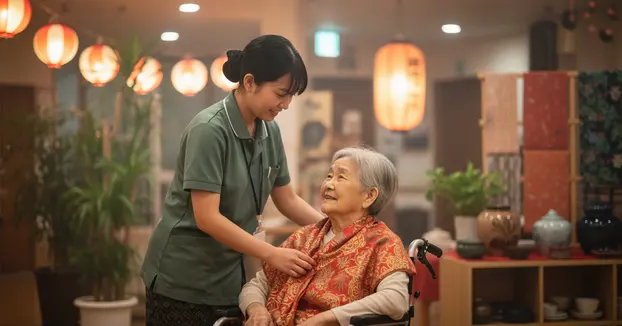
Myanmar Talent and Specified Skilled Worker “Nursing Care”: A Complete Practical Guide to Hiring
As labor shortages in the nursing care industry grow more severe, more companies are hiring Myanmar talent under Specified Skilled Worker “nursing care.” Understanding the system alone is not enough, however: without consideration for Myanmar-specific culture, religion, and daily customs, even successful hires often lead to early turnover. This article systematically covers the system fundamentals executives and HR staff need to know, real consultation cases arising on the ground, points hiring managers often overlook, and a practical checklist for retention support.
Why Myanmar talent is drawing attention in nursing care
Myanmar is one of the Southeast Asian countries where the dispatch of technical intern trainees and Specified Skilled Worker talent to Japan is expanding rapidly. Behind this are limited domestic employment opportunities, growing enthusiasm for Japanese language study, and expectations that work in Japan will provide a stable source of income.
In nursing care, future estimates published by the Ministry of Health, Labour and Welfare project a shortfall of about 570,000 care workers by fiscal 2040, and filling demand with domestic talent alone remains difficult. Against this structural labor shortage, the government is institutionally supporting the acceptance of international talent through the Specified Skilled Worker system. For the overall picture of the system, the latest information is also published on an ongoing basis on the Ministry of Health, Labour and Welfare’s foreign worker employment measures page, so hiring managers should check it regularly.
A characteristic of Myanmar talent is that many practice Buddhism (Theravada Buddhism) and come from a cultural background that values courtesy toward elders and supervisors. This is said to align well with nursing care as “work that stays close to people,” and feedback from the field indicates that evaluations from care recipients are relatively positive. At the same time, miscommunication arising from differences in Japanese ability and daily customs has also been reported, so the design of the acceptance framework is the key to retention.
Basics of Specified Skilled Worker “nursing care” and accepting Myanmar talent
The Specified Skilled Worker system is a status of residence created in 2019 that accepts international talent with a certain skill level and Japanese language ability in designated industrial fields, including nursing care. To work in nursing care as Specified Skilled Worker (i), candidates are in principle required to pass the Nursing Care Skills Evaluation Exam and the Nursing Care Japanese Language Evaluation Exam, or to hold JLPT N4 or higher.
When hiring Myanmar talent, two routes are common: through a local sending organization, and through a change of status from technical intern trainees or international students already residing in Japan. In Myanmar in particular, domestic political conditions can cause fluctuations in how sending organizations operate, so verifying the actual situation of a sending organization must be done even more carefully than usual.
For detailed system requirements and the latest operational rules, it is essential to check official information on the Immigration Services Agency of Japan’s Specified Skilled Worker system page. Applications for a Certificate of Eligibility for the Specified Skilled Worker status of residence require multiple documents, including the employment contract and support plan, and there is a risk of non-issuance if requirements are not met. When you need to confirm the statutory basis of the system accurately, it is also practically useful to refer directly on e-Gov to the text of the Immigration Control and Refugee Recognition Act and related ministerial ordinances.
For hiring practices for international talent more broadly, our foundational article on hiring foreign workers also explains the overall acceptance flow and required documents, so companies accepting Specified Skilled Worker talent for the first time are encouraged to review it as well. If you want to understand the differences from accepting highly skilled professionals, the explanation of statuses of residence for highly skilled foreign professionals is also a useful reference.
Diagram: Pre-hiring confirmation flow
When hiring managers accept Myanmar talent under Specified Skilled Worker, proceeding with confirmation in the following sequence makes it easier to avoid gaps. We organize the written explanation in the order of the flow.
In the first stage, confirm that your organization falls under an eligible designated industrial field (nursing care) and put in place a collaboration framework with a Registered Support Organization. In the second stage, confirm the candidate’s status of residence, skills exam pass status, and Japanese language ability. Those who have successfully completed Technical Intern Training (ii) may be exempt from exams in some cases, so verifying career history is especially important.
In the third stage, confirm that employment conditions (wage levels, working hours, and whether housing support is provided) are equal to or better than those for Japanese workers, and prepare the employment contract. In the fourth stage, file an application for permission to change status of residence or for a Certificate of Eligibility with the Immigration Services Agency of Japan, and at the same time make the support plan concrete (life orientation, Japanese language learning support, establishment of a consultation desk, and so on). In the final fifth stage, through pre-joining orientation, prepare the entire workplace for acceptance in light of Myanmar’s cultural background (religious considerations, meals, views on leave, and so on).
You do not need to perfect this flow all at once, but clarifying who is responsible at each stage helps avoid the failure patterns described later.
Myanmar culture, religion, and daily customs, and workplace considerations
Cultural consideration is as important as system understanding in determining whether Myanmar talent will stay.
On religion, a majority of the population practices Theravada Buddhism, and many people value Buddhist observances such as full moon days. Leave requests can concentrate around certain festival days, so grasping the calendar of major Buddhist events in advance makes shift planning easier. Strict dietary restrictions such as fasting are not common, but some people refrain from meat for a period as a form of devotion, so consideration in the company cafeteria or when bringing in food leaves a good impression.
In daily customs, there is a culture of showing strongly respectful attitudes toward elders and supervisors, and a tendency to refrain from direct disagreement or expressing opinions. For that reason, a reply of “there is no particular problem” may actually be a sign of dissatisfaction that is hard to voice. Holding regular one-on-one meetings and using multiple-choice questions (formats that have the person choose from several options rather than yes/no) makes it easier to draw out true feelings.
Name notation and forms of address also require care. In Myanmar it is common not to have a family name and to use only a personal name, so fitting names directly into Japanese document formats (family name / given name fields) can cause confusion. On this point, our article on workplace communication with Myanmar talent explains name structure and address etiquette in detail, so sharing it with both HR and the front line before acceptance helps prevent trouble.
On food, many people do not avoid pork, but some have specific dietary customs during religious events, so it is reassuring to ask in advance for internal events. There is also a culture that places importance on remittances to family, so explaining the pay structure and take-home amount with particular care builds trust.
Common consultations from the field
Actual nursing care workplaces have raised consultations such as the following regarding acceptance of Myanmar Specified Skilled Worker talent.
The first is concern that “handovers in Japanese may not be getting across accurately.” For care records and handovers that use many technical terms and abbreviations, rephrasing into plain Japanese (yasashii nihongo) and preparing manuals with furigana are considered effective.
The second is that “cultural misunderstandings arose in interactions with care recipients or their families.” For example, not making eye contact when speaking with superiors, or bowing deeply, can be misread by Japanese care recipients as “distant” or aloof. Sharing cultural background with the entire workplace in advance can prevent such misunderstandings.
The third is that “managing status of residence renewal timing is cumbersome.” Specified Skilled Worker (i) has a defined upper limit on the period of stay, and failing to complete renewal procedures can impede continued employment, so HR needs a schedule management system.
Fourth, consultations that “dealings with the sending organization involved opaque fees or contract terms” are not uncommon. In such cases, it is recommended to review contract details through consultation with Hello Work, a Registered Support Organization, or specialists such as administrative scriveners (gyoseishoshi).
Points hiring managers often overlook
A point hiring managers often overlook first is the “gap between JLPT pass level and the Japanese actually needed on the job.” Passing N4 is only the minimum system requirement; you need to understand that it differs from the conversational and reading ability required on actual care floors. Without building post-hire Japanese learning support into the plan, communication breakdowns can lead to lower work efficiency and accident risk.
Next often overlooked is the “effectiveness of the support plan.” Even if life orientation and a consultation desk are written on paper, they mean little if they do not actually function. Regular monitoring and a framework in which support staff can take consultations in substance, not only in form, are important.
In addition, “insufficient advance explanation to Japanese colleagues” is a typical oversight. Without training that promotes understanding of Myanmar culture not only for the person being accepted but also for existing staff, friction on the floor becomes more likely.
Finally, on the requirement that wages and working conditions be “equal to or better than those for Japanese workers,” it is also easy to overlook that comparison must cover overall treatment including allowances and bonuses, not only base pay. This is an important matter also checked in Immigration Services Agency of Japan reviews, and ambiguous practice can lead to administrative guidance or denial of status of residence.
Failure patterns and how to avoid them
We organize failure patterns and avoidance measures that emerge from past acceptance cases.
The first failure pattern is cases where “cultural consideration was put off and only system compliance was prioritized, resulting in early turnover.” An effective avoidance measure is to advance design of cultural training and life support frameworks in parallel as soon as hiring is decided. System response and cultural response should not be separated; they need to move on the same timeline.
The second is the pattern of “selecting a sending organization on price alone, so support quality did not follow.” As an avoidance measure, compare multiple sending organizations on track record, past trouble cases, and collaboration history with Registered Support Organizations, and where possible confirm reputation from companies that already have acceptance experience.
The third is cases where “status of residence renewal management was left to the front line and deadline control was missed.” An avoidance measure is for HR to maintain a company-wide status of residence management ledger and create a mechanism that raises alerts three months before renewal.
The fourth is the pattern where “insufficient explanation to Japanese staff led to deteriorated workplace relationships after acceptance.” An effective avoidance measure is, in pre-acceptance training, to share not only Myanmar talent’s cultural background but also the management rationale for why accepting international talent is necessary for the company, raising buy-in among existing staff.
What these failure patterns share is leaning too far toward either “system-side response” or “people- and culture-side response.” Having judgment criteria yourself as a hiring manager to advance both wheels is a shortcut to higher retention.
Practical checklist
Below are practical points to confirm when accepting Myanmar talent under Specified Skilled Worker “nursing care.”
- Have you confirmed the candidate’s status of residence, skills exam pass status, and Japanese ability (N4 or higher, or pass of the Nursing Care Japanese Language Evaluation Exam)?
- Have you scrutinized the track record, contract terms, and fee structure of the sending organization and Registered Support Organization?
- Have you confirmed that employment conditions are equal to or better than those for Japanese workers, including base pay, allowances, and bonuses?
- Is the support plan (life orientation, Japanese learning support, consultation desk) set up to function in substance, not only on paper?
- Have you put in place a mechanism for HR to centrally manage the status of residence renewal schedule?
- Have you conducted advance training for the entire accepting workplace on Myanmar religious events, food customs, and forms of address?
- Have you provided an opportunity to explain to existing Japanese staff the purpose of accepting international talent and the cultural background?
- Have you clearly assigned someone to regularly check the latest information from the Immigration Services Agency of Japan and the Ministry of Health, Labour and Welfare?
Frequently asked questions (FAQ)
Q1. When hiring Myanmar talent under Specified Skilled Worker “nursing care,” is JLPT N4 or higher always required? A. In principle, N4 or higher or a pass on the Nursing Care Japanese Language Evaluation Exam is required, but those who have successfully completed Technical Intern Training (ii) may be exempt from exams in some cases. We recommend confirming individual cases against official information from the Immigration Services Agency of Japan.
Q2. How far is leave accommodation for Myanmar religious events necessary? A. It is not a legal obligation, but cases have been reported in which grasping the calendar of major Buddhist events and showing consideration in shift adjustments contributes to higher retention. What matters is not compulsion but a posture of hearing the individual’s wishes.
Q3. If trouble arises with a sending organization, where should we consult? A. First consult your Registered Support Organization or your company’s advising administrative scrivener (gyoseishoshi), and as needed consider using Hello Work or Ministry of Health, Labour and Welfare consultation desks. Early specialist consultation is recommended when contract terms are opaque.
Q4. How long is the period of stay for Specified Skilled Worker (i)? A. It is capped at a total of five years. Building an internal management system so renewal timing is not missed is essential. For details, check related laws on e-Gov or refer to the Immigration Services Agency of Japan’s official pages.
Q5. What is the most effective initiative for post-hire retention support? A. From on-site consultation cases, many voices say that combining regular one-on-one meetings with cultural understanding training that includes Japanese staff is effective. Beyond system compliance, emphasizing trust-building between people becomes the judgment criterion.
Accepting Myanmar talent under Specified Skilled Worker “nursing care” is not enough if only system requirements are met. Understanding cultural background and building a support framework that involves the entire workplace are what lead to long-term retention and stable workplace operations. If you are unsure about building an acceptance framework in-house, consulting specialist staff via Foreign Talent Insights inquiries is one option. Holding a balanced view of both system and culture is essential to successful international talent hiring in nursing care going forward.
Where to check official information
Systems, employment management, and official announcements by country are updated over time, so also confirm the following primary sources before and after publication.
Immigration Services Agency of Japan Specified Skilled Worker system page — check and cross-reference the latest systems, employment management, and official announcements.
Ministry of Health, Labour and Welfare foreign worker employment measures page — check and cross-reference the latest systems, employment management, and official announcements.
e-Gov Law Search — check and cross-reference the latest systems, employment management, and official announcements.
Related articles: practical topics to review together
Also review practical articles on related themes as needed.
 Written by

ヤマシタハヤト
Share this article


