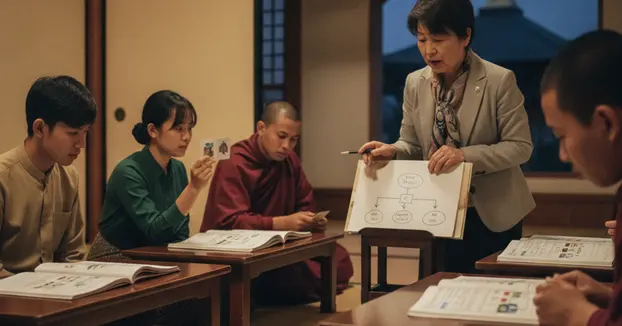
How to Put Myanmar Workers’ Japanese Learning to Work on the Job | A Practical Guide for HR and Leadership
Talent from Myanmar has rapidly raised its profile in recent years across manufacturing, construction, nursing care, food service, and other sectors. According to the Ministry of Health, Labour and Welfare’s reporting on the employment status of foreign workers, the number of resident workers of Myanmar nationality has risen markedly over the past several years, with many employed under statuses of residence such as Technical Intern Training, Specified Skilled Worker, and Engineer/Specialist in Humanities/International Services. Strengths hiring companies commonly cite are diligence, a strong desire to communicate, and affinity with Japanese culture.
At the same time, challenges never stop: “We thought Japanese was getting through, but it wasn’t,” “The intent of instructions doesn’t land,” and “Hou-Ren-Sou (report, contact, consult) never takes root.” When you unpack the root of these issues, it becomes clear that linguistic barriers alone are not the whole story—differences in cultural communication style and gaps in the company’s acceptance framework are intertwined.
This article first organizes why Myanmar people study Japanese and the background behind that motivation, then explains the mechanisms of linguistic and cultural challenges. It also covers real consultation themes hiring managers face on the ground, failure-prone patterns and how to avoid them, and how companies can build Japanese-language support systems they can put into practice starting today—all in a form that connects directly to day-to-day work. We hope HR and leadership teams serious about retention and performance of Myanmar talent will read through to the end.
Why Myanmar people commit seriously to Japanese study—understanding motivation and background
Enthusiasm for learning Japanese in Myanmar stands out even among Southeast Asian countries. Behind it is a three-layer structure: economic motivation, cultural affinity, and well-developed education infrastructure. Understanding this is the starting point for designing appropriate support as an accepting organization.
Strong economic motivation
Average monthly income in Myanmar is only about 20,000 to 40,000 yen when converted. Income earned by working in Japan often reaches 8 to 12 times domestic levels even in manufacturing, construction, and agriculture. Strong expectations of improving living standards, including remittances to family, function as sustained motivation for Japanese study. A hallmark of Myanmar learners is that they do not treat study as a burden, but as a firm will to “master it for the family.”
Deep familiarity with Japanese culture
The spread of Japanese culture through anime, manga, and games is especially pronounced among younger people in Myanmar. Works such as Dragon Ball, One Piece, and Slam Dunk have been familiar from childhood, and many learners have repeatedly heard Japanese audio or seen subtitles before coming to Japan. Emotional motivation—“I learn because I like it”—links directly to high continuation rates, and motivation is less likely to bottom out than in countries where Japanese study is treated mainly as an obligation.
Well-developed sending organizations and Japanese-language schools
Myanmar has many organizations specializing in sending workers to Japan, with curricula aimed at JLPT (Japanese-Language Proficiency Test) N4 to N3. Completing 300 to 500 hours of Japanese study before departure is standard, and many join companies already able to handle basic daily conversation.
That is a major strength for hiring managers. At the same time, it is essential to grasp the reality that “JLPT level at hire” does not necessarily match practical workplace communication ability.
The “linguistic distance” between Burmese and Japanese—five walls learners must clear
Burmese (Myanmar language) and Japanese belong to entirely different linguistic families. Correctly grasping this “linguistic distance” on the company side is an indispensable perspective when designing realistic support systems.
Wall 1: Complexity of the writing systems
Burmese uses its own circular Burmese script. Japanese switches among four scripts—hiragana, katakana, kanji, and romaji—depending on context. When work instructions and safety notices on manufacturing floors contain many kanji, even N4 passers often cannot read them. Voices such as “I can read the characters but don’t know the meaning” and “I give up because of how many kanji there are” come up repeatedly in interviews with on-site acceptance staff.
Wall 2: Multilayered keigo and polite language
Japanese has multilayered styles: plain form, polite form, and keigo (respectful, humble, and polite language). Burmese has honorifics, but not the same grammatical complexity as Japanese. Becoming able to switch between forms such as “~shimashita” and “~itashimashita” when reporting to a supervisor, depending on the situation, has limits in classroom study alone; on-the-job training at the workplace is essential.
Wall 3: Unspoken understanding and a “read the air” culture
Japanese business communication often involves few explicit instructions and expects people to “read the air” and sense what is between the lines. When Myanmar talent answers “I understand,” they may not actually understand. That is not a lack of sincerity; it stems from Myanmar-specific interpersonal norms—difficulty saying no and cultural resistance to refusal.
Wall 4: Listening comprehension and phonetic difficulty
Japanese long vowels, geminates, and moraic n (ー, っ, ん) are phonemes that do not exist in Burmese, so confusion easily arises in listening. Oral instructions in noisy environments such as factories, kitchens, and construction sites are especially hard to catch. Combining text and visual aids contributes greatly to understanding and retention.
Wall 5: On-site vocabulary and industry jargon
Workplaces overflow with vocabulary not taught in textbooks: counters such as ko, hon, mai, and satsu; how to read part and model numbers on manufacturing floors; and industry-specific abbreviations and code words. At companies that do not prepare an “on-site vocabulary list” after hire, this wall becomes a direct factor raising turnover risk within the first three months.
Common on-site consultations—the reality of workplace communication
Among consultations received by the Foreign Talent Insights editorial team, most related to Myanmar talent converge on the pattern “We thought Japanese was getting through, but it wasn’t.” Below are three typical consultation cases.
Consultation example 1: They reply, but behavior does not change
Consultations from manufacturing line supervisors—“I carefully explained a procedure change orally, but the next day they were still working the old way”—are very common. This is not a comprehension problem so much as a structural one: “In the moment it felt clear, but there was no way to check later,” and “The previous procedure is ingrained in the body.” Adding a paper handout that diagrams the changes to the oral explanation often resolves the same type of issue.
Consultation example 2: Mistakes go unreported, or are reported only after problems grow
Consultations such as “They quietly handled small mistakes” and “They only reported after the problem became serious” also appear frequently. Strong aversion in Myanmar culture to “losing face” often inhibits reporting behavior. Standardizing a Japanese mistake-report form in advance and embedding a workplace culture that evaluates the act of reporting itself is an effective countermeasure.
Consultation example 3: Japanese study stalls after joining
Japanese that was studied eagerly before arrival sometimes plateaus after hire. Beyond being too busy with work to secure self-study time, a major environmental factor is that “workplace conversation always follows the same patterns, so vocabulary does not expand.” Workplaces that set aside 15 to 30 minutes of Japanese study during working hours clearly improve retention.
For workplace communication more broadly, including names and forms of address for Myanmar talent, also see our article on Myanmar talent names and workplace communication.
Failure patterns and how to avoid them—miscommunication that often arises after hire
Below we organize failure patterns that companies accepting Myanmar talent repeat, and practical ways to avoid each one.
Failure pattern 1: Treating JLPT level as the only hiring criterion
The assumption that JLPT N3 equals “can use Japanese” is a major risk. N3 measures foundational reading and writing; it is not the same as real-time oral communication at work. Incorporating simple role-plays in interviews—such as “report lateness to a supervisor” or “repeat and confirm a work procedure”—functions as a criterion for practical Japanese ability.
Avoidance measure: Always include an “oral communication simulation” in hiring interviews. Add evaluation items such as naturalness of speech and whether the candidate can ask again when they do not understand.
Failure pattern 2: Leaving Japanese support “up to the individual”
A passive company stance—“Japanese is something you study on your own”—is one of the biggest drivers of early turnover among international talent. The Ministry of Health, Labour and Welfare’s “Guidelines on Improving Employment Management of Foreign Workers” recommend that employers actively support foreign workers’ Japanese acquisition. Lack of support can also connect to compliance risk—something companies should recognize.
Avoidance measure: Create a 90-day post-hire “Japanese onboarding plan” and designate a person responsible for weekly follow-up (a senior employee, interpreter support staff, etc.).
Failure pattern 3: Making a “Japanese-capable compatriot” the all-purpose interpreter
Assigning a senior employee from the same Myanmar background as interpreter can appear to solve problems at first. Over time, however, a triple problem surfaces: the interpreter’s core job efficiency falls, information is not conveyed accurately (mistranslation or omission), and if the interpreter leaves, the organization becomes dysfunctional.
Avoidance measure: Clearly allocate time to the interpreter role as “interpreting work” and reflect it in performance evaluation. In parallel, gradually build visual manuals and multilingual apps.
Failure pattern 4: Guidance that ignores cultural context
In Myanmar culture, public reprimand—especially emotional criticism in front of other employees—causes serious “loss of face,” after which repairing the relationship becomes extremely difficult. Cases of sudden resignation or unexcused absence after a reprimand correlate strongly with this cultural background.
Avoidance measure: Always give feedback one-on-one, in a form that conveys specific behavioral improvements. Avoid emotional tone and aim for future-oriented dialogue about “what to do next.”
For foundational knowledge on hiring foreign workers overall, also review how foreign hiring works and how to use recruitment agencies.
Points hiring managers often overlook, and decision criteria
At the hiring stage and in early post-hire follow-up, there are points managers overlook without realizing it.
Point 1: Differences in the quality of pre-arrival learning environments
Even among JLPT N3 passers, conversation ability, listening, and vocabulary can differ greatly between graduates of major Japanese schools in Yangon and those from small regional institutions. Sending organizations also differ in education quality, curriculum content, and practice volume. Confirming not only the score on paper but specifically “where, for how long, and by what method they studied” in the interview raises the accuracy of ability assessment.
Point 2: How religion and daily customs affect Japanese study time
Myanmar is predominantly Buddhist (about 87% of the population follows Theravada Buddhism), with customs such as vegetarian/ascetic meals, almsgiving events, and Uposatha observance days. These habits affect how time is used outside work and whether evening self-study or weekend Japanese classes are feasible. Designing together with the individual, before hire, “how to secure time to learn Japanese” contributes to better retention.
Point 3: Gaps between status of residence and Japanese ability requirements
Immigration Services Agency of Japan rules for each status of residence do not always expressly require high Japanese ability. Yet Japanese ability from the standpoint of “Can they perform work safely?” and “Can they act appropriately in an emergency?” is more important in practice than what statutes prescribe. Especially in manufacturing, construction, and nursing care, Japanese ability sufficient to understand occupational safety and health training becomes a de facto hiring criterion.
Point 4: Ownership of the Japanese side’s “acceptance posture”
At companies where a passive attitude—“Of course foreigners should learn Japanese”—pervades the whole workplace, retention of international talent tends to be low. Two-way efforts, including improving Japanese staff’s “Easy Japanese” skills and cross-cultural understanding training, become important decision criteria for enabling international talent to thrive. Hello Work also offers consultation and information services on employing foreign workers, and support schemes in partnership with regional labor bureaus can be used.
Company support systems to keep Japanese learning going at work
Companies that treat Japanese study as “something before hire” and those that treat it as “something to support continuously after hire” show a clear difference in three-year retention. Below are support measures whose effectiveness has been confirmed in practice.
Measure 1: Set Japanese study slots during working hours
At companies that set 15 to 30 minutes after morning assembly once or twice a week as “Japanese mini study time,” improvement in Japanese ability over the first year after hire is clearly visible. Materials such as NHK Easy Japanese content and industry-specific vocabulary cards are easy to introduce. The fact that “the company allocates time for learning” also positively affects willingness to keep working.
Measure 2: “Easy Japanese” training for OJT supervisors
“Easy Japanese” is a communication approach that adjusts vocabulary, grammar, and expressions so foreigners can understand more easily. When OJT supervisors acquire this skill, mutual understanding with Myanmar talent whose Japanese is limited improves dramatically. Even a two- to three-hour external training can produce quick change, and company-paid tuition also raises supervisors’ motivation.
Measure 3: Multilingual internal documents
Prepare internal documents such as work procedures, safety rules, emergency contact lists, and shift schedules in Burmese–Japanese bilingual form. Even without full translation, adding Japanese furigana (ruby) to key passages greatly improves understanding. Visual manuals combining diagrams, photos, and icons have high immediate impact regardless of Japanese level.
Measure 4: JLPT exam fee support and pass incentives
At companies that subsidize JLPT exam fees (about 5,500 to 6,000 yen for N3–N2) and pay a lump-sum bonus on passing, motivation for voluntary Japanese study is easier to sustain. The sense that “the company is investing in my career” strengthens retention and belonging at work.
Measure 5: Securing bilingual mentors and using external providers
When securing bilingual talent in-house is difficult, outsourcing to support firms specializing in international talent is also effective. Providing regular counseling and consultation opportunities builds a system that resolves language-related anxiety early and catches early signals of resignation.
Consultations on designing concrete support systems and hiring plans are accepted via the Foreign Talent Insights contact desk.
Diagram: Pre-hire confirmation flow (visualization candidate)
Below is the confirmation flow from hiring Myanmar talent through designing Japanese support. It is structured so it can be turned into an infographic as-is when requesting a diagram from a designer. The overall flow has four phases: pre-hire, onboarding, first 90 days after hire, and long-term retention.
Items to confirm in the pre-hire phase are as follows. First, document-check JLPT attainment level; next, conduct a practical check of oral communication ability (interview role-play). Then confirm the type of status of residence and renewal requirements based on Immigration Services Agency of Japan guidelines; finally, confirm the sending organization’s reliability and education quality.
In the onboarding phase, designate an OJT supervisor and deliver Easy Japanese training; distribute Burmese–Japanese bilingual onboarding guides and safety rules; and explain the workplace mentor and interpreter support setup to the individual.
In the first-90-days phase, run weekly follow-up meetings (three aspects: Japanese, work, and daily life) and implement Japanese mini study slots during working hours. Simple Japanese ability assessments at the one-month and three-month marks are recommended.
In the long-term retention phase, continue JLPT exam support and pass-incentive announcements, present career paths linked to Japanese improvement, and regularly survey workplace satisfaction and the communication environment.
Practical checklist—steps to build Japanese and communication support
Items hiring managers and acceptance staff should confirm, organized by stage. This list can be used as-is as an internal acceptance preparation sheet.
Hiring and selection stage checks:
- Have you verified the JLPT level attained through documentation?
- Have you verified oral communication skills through interview role-play?
- Have you confirmed the sending organization’s education curriculum and hours of study?
- Have you confirmed the type of status of residence and the period of stay and renewal requirements?
- Have you explained the outline of post-hire Japanese language support to the candidate?
Onboarding preparation checklist:
- Have you assigned an OJT supervisor and shared the basics of Easy Japanese?
- Have you prepared Burmese–Japanese bilingual onboarding guides and safety rules?
- Have you prepared emergency contact and medical facility lists in Burmese?
- Have you explained work rules and shift management using translation tools or an interpreter?
- Have you prepared a workplace vocabulary list (industry-specific glossary)?
Post-hire follow-up checklist:
- Have you set aside Japanese mini-learning sessions once or twice a week?
- Have you scheduled weekly follow-up meetings?
- Have you established standard forms and systems that make it easy to report mistakes and concerns?
- Have you informed the individual about JLPT exam fee subsidy programs?
- Have you planned simple Japanese proficiency assessments at the 1-, 3-, 6-, and 12-month marks?
Long-term retention checklist:
- Have you clearly defined career paths and raise criteria linked to Japanese proficiency improvement?
- Are you regularly conducting interviews on workplace satisfaction and the communication environment?
- Are you conducting cross-cultural understanding training and Easy Japanese training for Japanese staff?
Frequently Asked Questions (FAQ)
Q1. When hiring Myanmar talent, how high a Japanese level should you require?
It varies by industry and job type, but as a general guideline, JLPT N4 or higher is often the practical safety line for manufacturing, agriculture, and construction, while N3 or higher is common for nursing care, customer service, and office work. However, rather than scores alone, place greater weight on whether the candidate can actually use Japanese for the job, and we strongly recommend conducting an oral test at the time of hiring. For Japanese language requirements by status of residence, refer to the latest guidelines from the Immigration Services Agency of Japan.
Q2. How should you respond when an employee’s Japanese proficiency plateaus after joining?
First, it is important to identify the cause of the plateau. Causes may include lack of learning opportunities, inability to secure time, declining motivation, or a workplace environment that hinders learning—and countermeasures differ accordingly. We recommend combining measures such as setting learning slots during working hours, introducing JLPT exam subsidies, and assigning bilingual mentors, then running PDCA cycles in 90-day units.
Q3. How should you put “Easy Japanese” into practice in the workplace?
The basic rules are as follows. First, keep each sentence short (aim for about 20 characters). Next, avoid katakana loanwords and abbreviations, and rephrase them in plain language (e.g., “manual” → “procedure guide”). Further, reduce negative forms and convert them to affirmative forms (“Please do not ~” → “Please do ~”). Convey important information in both text and diagrams or photos. Even a two- to three-hour training session for OJT supervisors alone can produce immediate improvements in workplace communication.
Q4. How can you prevent cases of sudden resignation among Myanmar talent?
There are always “warning signs” before a sudden resignation. Typical signs include increased absences, changes in facial expression or amount of speech, and a tendency toward isolation in the workplace. Making weekly follow-up meetings a habit and catching workplace stress and concerns early—while using interpreter support—is the most effective preventive measure. It is also important to inform all Japanese staff that emotional reprimands in public can easily lead to loss of face in Myanmar culture and may become a direct trigger for resignation.
Q5. Is it acceptable to make improvement in Japanese proficiency a requirement for raises and promotions?
Legally, there is no problem. However, it is essential to clearly state the evaluation criteria in advance and obtain the individual’s agreement. By setting concrete and transparent standards such as “JLPT N3 attainment: hourly wage increase of ○○ yen” or “N2 attainment: eligible for promotion to a leadership role,” you can improve motivation and ensure fairness at the same time. We also recommend referring to the Ministry of Health, Labour and Welfare guidelines on the treatment of foreign workers and designing the system from the perspective of equal treatment.
---
Supporting Japanese language learning for Myanmar talent is not merely “providing language education,” but a management investment to help hired talent settle into the workplace and thrive as long-term assets. It is necessary to comprehensively understand the three elements of linguistic distance, cultural background, and workplace environment, and to combine appropriate support at each phase—before hiring, at onboarding, and after joining.
Many of the challenges framed as “Japanese doesn’t get through” are in fact also problems with how the Japanese side communicates and with support systems. By spreading Easy Japanese, preparing multilingual manuals, and building continuous learning support mechanisms, creating an environment where Myanmar talent feel “I want to work at this workplace for a long time” becomes a solid foundation for sustainable use of international talent. If you need specialized support from designing hiring plans through establishing acceptance systems, please feel free to consult Foreign Talent Insights.
Related Articles: Practical Topics Worth Reviewing Together
Please also review practical articles on related themes as needed.
 Written by
Share this article


