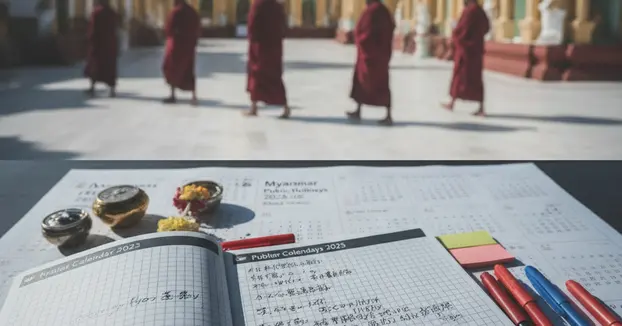
Myanmar Holiday Calendar 2025–2026 | A Complete Cultural Guide for HR Managers
HR managers at companies that employ Myanmar talent continually report issues such as “everyone requested leave in April and our shifts fell apart” or “we don’t understand why absences cluster at certain times.” In many cases, the root cause is insufficient understanding of Myanmar’s distinctive holiday and religious-observance calendar.
Myanmar is a multi-religious, multi-ethnic country centered on Theravada Buddhism. In addition to fixed national holidays, numerous Buddhist and traditional observances based on the lunar (Myanmar) calendar run throughout the year. These events are not mere “days off”; they carry deep cultural meaning and a sense of social obligation rooted in family, community, and faith. Whether HR managers understand this background in advance directly affects retention and workplace satisfaction among Myanmar talent.
This article organizes the major Myanmar holidays for 2025 and 2026 in detail and explains, from an HR perspective, each event’s cultural meaning, its impact on the workplace, and practical response measures. Use it as foundational information for more accurate annual labor planning and for building long-term trust with Myanmar talent—and please share it internally.
---
Myanmar’s holiday system: a two-layer structure of national holidays and Buddhist calendar observances
Myanmar holidays fall broadly into two layers: “national holidays (fixed dates)” and “movable holidays based on the lunar/Buddhist calendar.” Grasping this structure—which can be hard to grasp if you are used to the Japanese calendar—is the starting point for annual shift management and labor planning.
National holidays (same date every year)
The fixed national holidays designated by the Myanmar government are as follows.
- January 4: Independence Day, commemorating independence from Britain in 1948. One of the most important political holidays for the nation.
- February 12: Union Day, commemorating the signing of the Panglong Agreement in 1947 and symbolizing the unity of more than 135 ethnic groups.
- March 2: Peasants' Day, honoring the labor of farmers in agricultural Myanmar.
- March 27: Armed Forces Day / Resistance Day, a historical holiday commemorating the start of resistance against Japanese forces.
- May 1: Workers' Day, on the same date as International May Day.
- July 19: Martyrs' Day, mourning the assassination of General Aung San and other founding fathers. Carries especially heavy national emotional weight.
- December 25: Christmas Day, officially recognized as a Christian holiday.
Movable holidays based on the lunar/Buddhist calendar
Observances based on the lunar calendar change date every year. We strongly recommend that HR managers standardize a process of confirming the latest observance dates each January and reflecting them in shift and paid-leave planning.
---
2025–2026 Myanmar holiday and major observance calendar
Below is a summary of major holidays and observances for 2025 and 2026. Dates for Buddhist-calendar observances vary by year. 2026 Buddhist-calendar dates include estimates, so always make a final check against the Ministry of Foreign Affairs of Japan basic data on Myanmar and official announcements from the Embassy of Myanmar.
2025 major Myanmar holidays and observances
- January 4 (Sat): Independence Day
- February 12 (Wed): Union Day
- March 2 (Sun): Peasants' Day
- March 27 (Thu): Armed Forces Day
- April 13–16 (Sun–Wed): Thingyan (Water Festival) eve through main festival
- April 17 (Thu): Myanmar New Year (1387)
- May 1 (Thu): Workers' Day
- July 10 (Thu): Waso Full Moon (start of Buddhist rains retreat / Waso Day)
- July 19 (Sat): Martyrs' Day
- October 6–7 (Mon–Tue): Thadingyut Festival (end of Buddhist rains retreat / Festival of Lights)
- November 5 (Wed): Tazaungmon Festival (Kason Full Moon)
- November 19 (Wed): National Day, which varies each year based on the lunar calendar
- December 25 (Thu): Christmas
- Late December: Karen New Year, date subject to change
2026 major Myanmar holidays and observances (partly estimated)
- January 4 (Sun): Independence Day
- February 12 (Thu): Union Day
- March 2 (Mon): Peasants' Day
- March 27 (Fri): Armed Forces Day
- April 13–16 (Mon–Thu): Thingyan (Water Festival)
- April 17 (Fri): Myanmar New Year (1388)
- May 1 (Fri): Workers' Day
- Around July: Waso Full Moon (start of Buddhist rains retreat); confirm the exact date early in the year
- July 19 (Sun): Martyrs' Day
- Around October: Thadingyut Festival (end of Buddhist rains retreat); confirm the exact date early in the year
- Around November: Tazaungmon Festival and National Day
- December 25 (Fri): Christmas
Exact dates for Buddhist-calendar observances (Thingyan, Waso, Thadingyut, and others) are confirmed after the Myanmar government publishes its annual calendar. Standardize an internal process of checking the latest information around January each year.
---
Cultural meaning of major holidays and concrete workplace impact
Treating Myanmar holidays as mere “headcount of days off” is a management risk. Only by understanding the cultural and spiritual weight of each observance can you provide appropriate labor responses.
Thingyan (Water Festival): the largest observance—effectively a 4- to 6-day consecutive break
Thingyan is Myanmar’s largest traditional observance. Washing away the impurities of the old year with water to welcome the new year, it carries meaning similar to a combination of Japan’s Obon and New Year. The whole country enters a homecoming and family-reunion mode, and roughly four to five days around April 13–17 become an effective consecutive break.
For Myanmar talent living in Japan as well, contacting family, sending remittances, and joining community events in Japan during this period are extremely important. Multiple field reports shared with YourBright indicate that for technical intern trainees and Specified Skilled Worker talent who have family remaining in regional areas, “whether they can take paid leave during Thingyan” has become a barometer of trust in the workplace. From a shift-management perspective, assume that nearly everyone will request at least one or two days of paid leave, and strongly recommend building this into the annual plan three months in advance.
Thadingyut Festival (end of Buddhist rains retreat / Festival of Lights): a major religious observance in October
This festival marks the end of the Buddhist rains retreat (a period of restricted movement from the full moon in July through the full moon in October), with offerings of light and alms at temples. It holds deep religious significance for Myanmar Buddhists, and cases of increased paid-leave requests and early-departure requests around this time have been reported.
Martyrs' Day (July 19): a politically and emotionally sensitive day
July 19, when General Aung San and other founding fathers were assassinated, evokes deep mourning and national feeling among Myanmar people. Since the February 2021 coup, the period around this day has been recognized as a time when the psychological state of Myanmar talent in Japan can become especially unstable. Whether managers know what the day means and can offer considerate outreach has a major impact on maintaining trust.
Union Day (February 12): a complex symbol of a multi-ethnic nation
Myanmar is a multi-ethnic nation with more than 135 recognized ethnic groups. Union Day symbolizes the unity of those groups, but emotional reception differs by ethnic origin and political stance. Where the workplace includes people from multiple ethnic backgrounds, care is needed not to impose a one-sided interpretation of the day’s meaning.
For the cultural background of Myanmar names and forms of address, see also the Guide to Myanmar Names and Forms of Address.
---
Diagram: cultural-consideration flow before hiring and throughout the year
Here is a step-by-step outline of how companies accepting Myanmar talent should build cultural consideration in from before hiring through the full year. Use it like a flowchart.
Step 1: Before hiring (before entry and assignment)
- Review the list of major Myanmar holidays and cross-check it against peak-season shift plans
- Plan staffing coverage for Thingyan (mid-April) and Thadingyut (October)
- State the paid-leave request flow and conditions for exercising the right to change leave timing in the employment contract, and explain them to the individual in plain language
Step 2: Joining through three months (onboarding period)
- Share the annual observance calendar and confirm key event periods with both sides
- Capture and record religious considerations (meals, worship, fasting, almsgiving, etc.) on a hearing sheet
- If senior employees of the same nationality are present, ask them to serve as cultural bridges
Step 3: Two to three months before Thingyan (January–February)
- Confirm paid-leave intentions with every individual and record them in writing
- Present shift-adjustment options early (rotation, transfer to alternative days, etc.) and build agreement
- Provide information on Thingyan community events in Japan
Step 4: Ongoing consideration throughout the year
- Obtain and update the latest Myanmar holiday calendar internally every January
- During the Buddhist rains retreat (July–October), avoid unreasonable overtime orders
- Offer simple check-ins around Buddhist observances—such as “This must be an important time for you”—to help maintain psychological safety
---
Common workplace issues: holiday and religious observance trouble cases
Common workplace issues we hear in recruitment support include the representative trouble cases below. When HR professionals understand these in advance, the quality of their initial response improves significantly.
Case 1: “All of our Myanmar talent applied for paid leave at once in April”
A case from an HR manager in manufacturing. All six Myanmar workers applied for paid leave together for April 13–17, disrupting production line operations. Managers blamed them for not consulting in advance, but the workers later said they had felt unable to speak up because they believed their Japanese supervisors did not understand how important the observance was.
Response: Treat Thingyan as equivalent to Myanmar’s year-end and New Year period, and plan shifts on the assumption that everyone may apply. Start discussions three months ahead so that three to four people can take leave on the core dates (April 13–17) and the rest can take alternative leave in late April to early May.
Case 2: “We don’t know why attendance suddenly dropped in July”
Around the full moon of Waso (the start of Buddhist Lent), several workers asked to visit a temple in the morning, and managers could not respond because they had no advance information. After the fact, the absences were treated as sudden no-shows and disciplinary guidance was given, which damaged relations between Myanmar talent and management.
Response: Share an annual events calendar at onboarding and set up a consultation channel for shift adjustments on the premise that morning temple visits may be requested around the Waso full moon.
Case 3: “Relations deteriorated overnight over a political comment”
A supervisor casually mentioned Myanmar’s political situation the day after Martyrs’ Day (July 19), and relations with several Myanmar staff deteriorated sharply. For many Myanmar talent in Japan, the current situation is a serious issue tied directly to family safety. D&I training for managers should always cover Myanmar’s political and historical background.
---
Failure patterns and how to avoid them
Failure patterns and how to avoid them are organized by type below. Identify recurring failures at the organizational level and build systems that get ahead of them.
Failure pattern 1: Assuming “if they apply under the work rules, we’ll approve it” is enough
In Japan, paid leave is typically requested one to two weeks ahead, but for Thingyan home visits or observances with religious obligations, planning often starts two to three months earlier because of flight and bus arrangements. Simply saying “we’ll approve if the application rules are followed” leaves you reacting too late and makes it harder for people to apply. HR needs to proactively confirm intentions.
Failure pattern 2: Brushing it off with “Please do that on your day off”
For Buddhists, visiting a temple and making offerings on certain full-moon days (Waso, Thadingyut, and others) carries a strong sense of religious and social obligation. Responding with “private religious activities belong on days off” seriously damages trust. Showing shift flexibility within the bounds of business needs supports long-term retention.
Failure pattern 3: Treating Myanmar talent as a single cultural or religious group
Ethnic groups are diverse—including Bamar, Karen, Kachin, and Shan—and religions include Buddhism, Christianity, Islam, and others. Assuming “they’re Myanmar, so they’re all Buddhist” and applying one-size-fits-all treatment has created discomfort and dissatisfaction. Individual interviews are best: ask, “Which observances matter most to you?”
Failure pattern 4: Information stops at onboarding and is never updated
Labor management information for international talent needs regular updates, referring to Hello Work and the Ministry of Health, Labour and Welfare foreign employment guidelines. Myanmar Buddhist calendar dates also change every year, so assign and standardize a workflow for obtaining and updating the latest calendar at the start of each year.
---
Points hiring managers often overlook, and decision criteria
Points hiring managers often overlook are summarized below. These are items HR teams hiring Myanmar talent for the first time should especially check.
1. Statutory paid leave alone may not cover observances
The paid leave obligations under Japan’s Labor Standards Act (see the e-Gov Labor Standards Act) are the minimum line you must meet. When Myanmar talent use paid leave for multiple observances such as Thingyan, Thadingyut, and Martyrs’ Day, annual leave balances can run short. From hiring onward, it is important to document special leave policies (unpaid leave is acceptable) and rules for rescheduling leave periods.
2. Lack of consideration for Buddhist dietary restrictions and fasting periods
Quite a few Myanmar Buddhists practice dietary restrictions or fasting during the Waso period (July–October). Flexibility on cafeteria menus and meal support during night overtime can directly affect workplace satisfaction.
3. Conditions in Myanmar continue to affect the psychology of talent in Japan
The political situation since February 2021 has continued to affect the mental health of Myanmar talent in Japan over the long term. Simply knowing that psychological strain is more likely around Martyrs’ Day and the coup anniversary (February 1) enables managers to offer appropriate check-ins and earlier coordination with occupational physicians or EAPs. The Immigration Services Agency of Japan publishes related information on institutional support for residence status.
4. Decision criterion: designing a balance between cultural consideration and business necessity
Approving every religious observance request unconditionally is not “consideration.” Applying a transparent flow—request → discussion → approval or alternative proposal—equally to all employees, and designing it so Myanmar talent are neither specially favored nor treated worse than Japanese employees, is the core of the decision criterion. Workplaces that strike this balance tend to see significantly lower turnover among Myanmar talent.
For the basic framework of hiring foreign nationals, also see the Basic Guide to Hiring Foreign Nationals.
---
Practical checklist: annual cultural consideration plan for Myanmar talent
Practical checklist: build the following items into your annual schedule. The checklist can also serve as handover material for HR staff.
Items for the start of the year (January)
- Obtain and share internally the latest Myanmar holiday and Buddhist calendar events
- Begin confirming shift coverage and staffing for the Thingyan period (mid-April)
- Update the religion and cultural observance hearing sheet and distribute it to all current staff
Items at hiring and onboarding
- Explain work rules and paid leave procedures in Burmese or plain Japanese
- Provide the annual events calendar and paid leave application flow in writing, and record that both sides confirmed them
- Interview and record religious considerations (meals, worship, fasting, offerings, etc.)
- Confirm residence card validity and renewal schedule using Immigration Services Agency of Japan procedure information
February–March (Thingyan advance preparation)
- Conduct written confirmation of paid leave intentions with all Myanmar talent
- Present shift adjustment options (alternative leave dates, rotation, etc.) and record agreements
- Brief managers on Thingyan’s cultural background (email, training, etc.)
July (start of Buddhist Lent and Martyrs’ Day)
- Confirm whether shift consideration is available for those who want morning temple visits around the Waso full moon
- Confirm that managers and consultation channels can offer mental health check-ins around July 19
October (Thadingyut Festival)
- Confirm paid leave and early-leave requests for end-of-Buddhist-Lent observances in advance
- Review annual paid leave usage and notify each person of remaining days (manage the mandatory five-day annual leave requirement)
Year-end (December)
- Obtain next year’s Myanmar holiday information early and reflect it in the following year’s annual plan
- Review cultural consideration efforts over the year and add improvements to records and handover documents
---
Frequently asked questions (FAQ)
Q1. Are Myanmar holidays valid reasons for taking paid leave at a Japanese workplace?
A. Under Article 39 of Japan’s Labor Standards Act, the reason for taking paid leave is up to the individual. There is no legitimate legal basis to refuse paid leave requested for religious or cultural observances, and approval is the principle except when it would interfere with the normal operation of the business. For concentrated requests during busy periods, exercising the right to change the timing of leave (Article 39, paragraph 6) is also an option. See the Ministry of Health, Labour and Welfare foreign employment guidelines for details.
Q2. Are all Myanmar talent Buddhists?
A. No. About 88–90% of Myanmar’s population are Theravada Buddhists, but many Karen and Kachin people are Christian, and Muslim talent also work in Japan. Do not assume religion uniformly; the best approach is individual interviews asking, “Which observances matter most to you?”
Q3. Should we send people home for Thingyan?
A. Whether to return home is, in principle, up to the individual. What companies can do is support paid leave and shift adjustments, and share information about Thingyan community events in Japan. Forcing a return home, or blocking a return without legitimate reason, both carry legal and relationship risks.
Q4. Where can I find accurate sources for Myanmar holidays?
A. The Ministry of Foreign Affairs Myanmar basic data page and official announcements from the Myanmar embassy are the most reliable sources. For movable holidays based on the Buddhist calendar, the Myanmar government publishes an annual calendar around year-end to the start of the year.
Q5. How can we keep cultural consideration from being seen as favoritism?
A. Establish a transparent paid leave and shift adjustment flow that applies to all employees, and document religious and cultural circumstances as one category of application reason. Designing treatment equivalent to Japanese employees’ memorial services and year-end home visits safeguards fairness.
---
Conclusion: Understanding the cultural calendar is key to higher retention
For long-term retention of Myanmar talent, “knowing the cultural calendar” is not mere information gathering—it is putting into practice the message “we respect your culture.” The experience of having paid leave carefully coordinated around Thingyan builds trust in the workplace that accumulates for years afterward.
At the same time, cultural consideration is not “special treatment.” Apply a fair flow to all employees while building in reasonable accommodations grounded in Myanmar talent’s cultural background. That balance is the practical design HR professionals need. The simple step of checking a holiday list becomes the starting point of a long-term retention strategy that makes hiring investment pay off.
For consultations on recruiting and retaining Myanmar talent, feel free to contact us via the Foreign Talent Insights inquiry form. We provide individualized support from the annual planning stage.
Related articles: practical topics to review together
Please also review related practical articles on nearby topics as needed.
 Written by
Share this article


