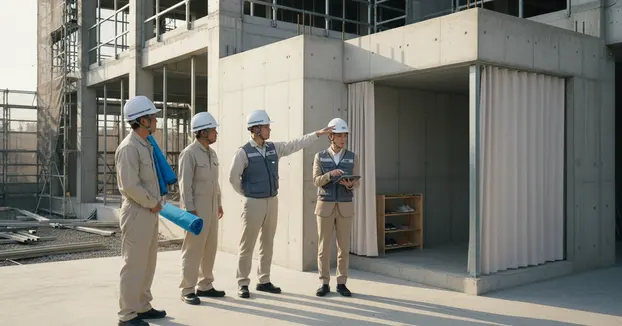
Prayer Accommodation for Indonesian Construction Workers: Practical Points Hiring Managers Need to Know
As the construction industry accelerates hiring of foreign skilled workers, Indonesian talent is drawing attention for diligence and strong skill acquisition. Since the Specified Skilled Worker system was put in place, Indonesia has rapidly gained presence as a sending country and ranks among the leading countries for Specified Skilled Worker residents in construction.
At the same time, hiring teams keep asking how to handle prayer times, how to secure space on outdoor sites, and how to manage heatstroke risk during the fasting month (Ramadan). Prayer accommodation is not mere hospitality; it is amanagement issue that directly affects whether people can keep working with peace of mind and whether retention improves. This article systematically organizes a prayer-accommodation framework that HR leads and executives can start using now, covering both the institutional side and day-to-day site practice.
---
Why Indonesian talent is concentrating in construction, and the current picture
Indonesia has a population of about 280 million and a still-growing working-age population. It is the world’s largest Muslim-majority country (Muslims are about 87% of the population, or roughly 230 million people). Japan’s construction industry has seen labor shortages become acute as overtime rules tightened under the so-called 2024 problem, and demand for foreign skilled workers who can contribute immediately has never been higher.
According to data published by the Immigration Services Agency of Japan, the number of residents under Specified Skilled Worker status in “construction” has roughly doubled in recent years, and Indonesia sits alongside the Philippines and Vietnam as a major sending country. The number of accepting companies registered with the Japan Association for Construction Human Resources (JAC) continues to rise, and sites welcoming Indonesian talent for the first time are increasing rapidly.
Against that backdrop, limited understanding of Islamic practices such as prayer (salat) has been reported in multiple cases as asource of early turnover soon after hire and of workplace friction. Accurately grasping religious background is essential when designing post-hire retention support. For the overall framework of hiring foreign workers, see also ourbasics of foreign worker recruitment.
---
Basics of Islamic prayer (salat) and impact on construction sites
Five daily prayer windows
For Muslims, five daily prayers (salat) are an important part of everyday faith practice. Prayer times are set by the sun’s position, so they shift by a few minutes each day with season and latitude. Approximate windows in Japan are as follows (summer, Kanto baseline).
- Fajr (dawn prayer): before sunrise, roughly 3:30–4:30 a.m.
- Zuhr (noon prayer): after midday, roughly 12:00–1:00 p.m.
- Asr (afternoon prayer): mid-afternoon, roughly 3:00–4:00 p.m.
- Maghrib (sunset prayer): immediately after sunset, roughly 6:30–7:30 p.m.
- Isha (night prayer): at night, roughly 8:00–9:30 p.m.
Of these, the ones that typically overlap a standard construction workday (roughly 8:00 a.m.–5:00 p.m.) areZuhr and Asr—two times. Depending on the schedule, early starts or overtime can also involve Fajr or Maghrib.
Environment and time required for prayer
A single prayer, including ablution (wudu), takes about15–20 minutesas a rule of thumb. Prayer requires a place that meets the following conditions.
- A clean space (areas with heavy dust, grease, or filth are not acceptable)
- Orientation toward Mecca (qibla) (from Japan, roughly northwest to west-northwest)
- Floor area large enough to spread a prayer mat (janamaz) (guideline: at least about 60 cm × 120 cm)
- Proximity to water for pre-prayer ablution (wudu)
Meeting all four conditions at once on a construction site is the main practical challenge.
Responding to Ramadan (the fasting month)
Ramadan follows the lunar (Hijri) calendar, so its Gregorian dates move about 10 days earlier each year. During the fast, people abstain from food and drink from sunrise to sunset, butwork itself usually continuesin the large majority of cases. Combined with hot outdoor work, however, heatstroke risk rises sharply, so additional site-management measures are essential. Indonesia’s Ministry of Religious Affairs (Kementerian Agama) presents prayer and fasting as core to the faith and clearly calls for reasonable accommodation by employers.
---
Common questions from the field
Common questions from construction-company HR leads and site supervisors cluster mainly into the following four categories.
1. Securing prayer time and adjusting the schedule Frequent questions include wanting to allow two prayer breaks of 15–20 minutes a day but not knowing how to build them into the schedule, and uncertainty about whether prayer may be skipped when the schedule suddenly slips.
2. Where to place a prayer space Many report offering a corner of a prefab office but hearing dissatisfaction from the worker, or being unable to secure roofed space on outdoor sites. Physical infrastructure becomes the issue.
3. Gray areas in meals and catering Questions also continue about asking a bento vendor to avoid pork but remaining unclear on alcohol in cooking, and whether halal and non-halal foods must be separated in a shared site refrigerator.
4. Friction over fairness with Japanese staff One of the most common concerns from site managers is Japanese employees asking why only certain people get extra breaks, and how to explain the need for prayer and meal accommodation so the site will accept it.
The fundamental solution common to all of these is todocument the prayer-accommodation policy in work rules and workplace rules before hiring, and communicate it to all staff.
---
Failure patterns and how to avoid them
Based on actual trouble cases, here are typical failure patterns and how to avoid them.
Failure pattern 1: Hiring on verbal promises only At interview the company said prayer could be done during break time, but after joining it became clear that prayer, wudu, and a meal could not all fit in a 45-minute lunch break. Distrust of the company grew and the person left within three months.
How to avoid it: At the offer stage,state dedicated prayer breaks (up to 20 minutes each) in a supplementary provision of the work rulesand record them in the notice of working conditions. Put verbal confirmation in writing and keep signed evidence from both sides.
Failure pattern 2: Deferring prayer-space setup until after the start date The plan was to hear the person’s requests after joining and then prepare the space, but it was not ready in time. The person had to pray in a restroom for a month. Distrust of the workplace spread on social media and damaged the employer brand.
How to avoid it: Treat a prayer space usable from day one as amandatory onboarding taskand manage it on the schedule. Even a partitioned corner of a prefab office with a prayer mat can work. Initial cost is roughly 30,000–50,000 yen.
Failure pattern 3: Skipping advance explanation to the Japanese team Prayer accommodation was not explained to the site supervisor, who treated a worker at prayer as “slacking off” and scolded them harshly. The person became reluctant to request prayer time, and mental stress led to poor health.
How to avoid it: Before acceptance, hold anall-hands briefingand explain the purpose and operating rules of prayer accommodation to every Japanese staff member. Present it not as “special treatment” but as a system written into the working conditions.
Failure pattern 4: Neglecting heatstroke measures during Ramadan During a summer Ramadan, a fasting worker developed dehydration symptoms on outdoor work and the site had to pause temporarily. A report to the labor bureau was required afterward, and the company’s credibility was affected.
How to avoid it: During Ramadan, shift outdoor work on extreme heat days to after sunset, or prioritize indoor assignments. Document measures in combination with the Ministry of Health, Labour and Welfare heatstroke manuals (see also theforeign worker employment measures page).
---
Points hiring managers often overlook
We emphasize the following five points that hiring managers often overlook.
1. Prayer frequency varies by individual Even among Indonesian Muslims, strictness of prayer practice varies. Quite a few people request only one Zuhr prayer during work hours. Assuming that “Indonesians = everyone requires all five prayers” is incorrect. Individual intake interviews at hire to grasp actual needs are the starting point for accurate support.
2. Do not postpone reflecting this in work rules If prayer breaks and health management during Ramadan stay verbal only, judgments diverge by site and affect trust and retention. The Ministry of Health, Labour and Welfare makes clear that ensuring appropriate working conditions for foreign workers is the employer’s responsibility, and accommodation of religious practice falls within appropriate treatment in a broad sense.
3. Do not underestimate water for wudu Before prayer, ablution of the hands, face, and feet (wudu) is required. Even if “there is a washbasin on site,” a basin fouled with mud and grease is effectively the same as denying a chance to pray. Placing one clean water point and a foot-washing basin near the prayer space greatly improves usability.
4. Alignment with the Specified Skilled Worker institutional framework Under the Specified Skilled Worker system set by the Immigration Services Agency of Japan, appropriate daily-life support for foreign nationals is important for accepting organizations (Specified Skilled Worker system page). Prayer accommodation falls under support for cultural and religious aspects and can affect how an accepting organization is evaluated for compliance. For details on status of residence, see also ourguide to status of residence for highly skilled foreign professionals.
5. Designing fairness with talent of other nationalities On sites where staff of multiple nationalities, such as Myanmar talent, work together, the presence or absence of prayer accommodation can surface as a “fairness issue.” Draft a consistent religious-practice support policy that does not turn on religion or nationality, and give the same explanation to all staff to protect a sense of internal fairness. For communication design in multinational teams, ourarticle on workplace communication with Myanmar talentis also useful.
---
Decision criteria and practical steps for setting up a prayer space
Decision criteria
The criteria for whether to provide a prayer space are clear. If you hire even one Indonesian Muslim, treat prayer-space preparation not as “nice to have” but as aprecondition for acceptance. Use the following criteria.
If one or more Muslim workers are on staff, a prayer space is required. If continuous on-site presence lasts one month or more, prioritize a fixed space. For short jobs under one month on site, a portable prayer mat plus a simple partition can suffice. When Ramadan overlaps summer, always redesign hydration and work schedules.
Practical steps
Step 1: Build agreement with the site lead and construction manager. Share the reasons and institutional background for a prayer space and secure site-management cooperation.
Step 2: Select candidate spaces. A meeting room or break corner inside a prefab office, or a small separate room, is ideal. Outdoors, a tented area with roof and shade can substitute. If you can secure roughly at least 1 m × 2 m of floor area, multi-person prayer is also feasible.
Step 3: Confirm the direction of Mecca (qibla). Use a smartphone qibla app to identify the direction (from Japan, northwest to west-northwest) and place a clear mark on the floor or wall.
Step 4: Prepare water. Keep an existing washbasin clean enough for pre-prayer wudu. Providing one low shower head or basin for foot washing alone greatly improves convenience.
Step 5: Stock two or three prayer mats as company equipment. At about 1,000–2,000 yen each, company-supplied mats concretely show that accommodation is intentional.
Step 6: Build prayer times into the schedule. Mark Zuhr (roughly 12:30–1:00 p.m.) and Asr (roughly 3:30–4:00 p.m.) as 15–20 minutes each of “religious break.” Design them so that, combined with other breaks, they do not conflict with internal break rules.
---
Diagram: Pre-hire confirmation flow
Below is a pre-hire confirmation flow for bringing Indonesian talent onto a construction site. Running all five stages of this flow can sharply reduce post-hire trouble.
Stage 1 is job-posting design. State on the posting that prayer space and halal arrangements are open to discussion, preventing mismatch before hire.
Stage 2 is individual screening interviews. Confirm directly with the candidate how many prayers are needed during work hours, whether they observe the fasting month, and meal restrictions (details of their halal standard). Grasp actual individual needs rather than uniform assumptions.
Stage 3 is documenting the offer and employment conditions. Record dedicated prayer-break conditions (time, place, and handling) in the notice of working conditions. At the same time, organize internal rules on prayer and meal support and record what was agreed with the person.
Stage 4 is preparing the acceptance environment. Complete prayer-space setup, water access, and prayer mats by day one. In parallel, brief Japanese staff in advance and communicate the purpose and operating rules of prayer accommodation to everyone.
Stage 5 is retention follow-up. At three months after hire, interview individually on satisfaction with the prayer environment and remaining issues, then record and implement needed improvements. This PDCA cycle is the key to long-term retention.
---
Practical checklist
Use the following practical checklist from hiring preparation through three months after the start date.
Hiring-preparation checks are as follows.
- Did you state on the job posting whether prayer and halal arrangements can be discussed?
- Did you interview on prayer needs and meal restrictions during selection?
- Did you record dedicated prayer-break conditions (time, place, and paid/unpaid status) in the notice of working conditions?
- Have you reflected prayer and meal accommodation policies in company rules?
Checklist items for site environment setup are as follows.
- Have you secured and prepared a prayer space (minimum 1 m × 2 m) by the first day of employment?
- Have you installed a Qibla (direction of Mecca) marker on the floor or wall?
- Have you put in place a system to keep the wudu (ablution) water area clean before prayer?
- Have you prepared at least two to three prayer mats as company equipment?
- Have you informed all staff of the location of the prayer space and how to use it?
Checklist items for schedule management are as follows.
- Have you clearly indicated Zuhr and Asr prayer time slots (15–20 minutes each) on the work schedule?
- Have you confirmed that daily break time including prayer breaks does not conflict with company break rules?
- Have you planned in advance a review of outdoor work schedules during Ramadan?
- Have you put in place heatstroke prevention measures during Ramadan (cooling vests, WBGT measurement, and work-hour shifts)?
Checklist items for retention support are as follows.
- Have you conducted a hearing on satisfaction with the prayer environment at the three-month mark after joining?
- Have you checked whether friction has arisen with Japanese staff regarding prayer accommodations?
- Are you keeping and updating in writing the prayer accommodation policy and improvement history?
---
Frequently Asked Questions (FAQ)
Q1. Do prayer breaks need to be treated as paid time?
There is no single required approach. Having employees complete prayer during lunch or tea breaks is the easiest to introduce and is adopted by many companies. Even if you set up a separate unpaid break dedicated to prayer, there is no problem as long as the individual consents and it is clearly stated in the work rules. In any case, written agreement is fundamental to preventing disputes.
Q2. Is a prayer room required even on small sites (fewer than 10 workers)?
On a small site with only one or two Muslim employees, partitioning off a corner of a prefab unit and laying out a prayer mat is fully functional. Initial investment is roughly 30,000 to 50,000 yen. There is no need to prepare a dedicated standalone room; what matters is showing the will to secure space.
Q3. What operational risks arise on site if prayer accommodations are refused?
Unilaterally refusing can create a sense of unfairness and distrust, leading to prolonged consultation responses, lower retention rates, and negative effects on recruitment publicity. When judgment is difficult, organize individual circumstances while consulting experts such as a labor and social security attorney. It also affects the proper evaluation of accepting organizations under the Specified Skilled Worker program as set by the Immigration Services Agency of Japan, so there are institutional risks as well.
Q4. How should heatstroke risk be managed during Ramadan?
Workers fasting during the day are at higher-than-usual risk of dehydration and low blood sugar. Referring to WBGT standards, consider switching to indoor work or moving the start time earlier (around dawn) on extreme heat days. We recommend documenting in company materials a combined approach that includes issuing cooling vests and strengthening cold-water shower facilities.
Q5. Are all Indonesian staff Muslim?
About 87% of Indonesian nationals are Muslim, but there are also significant numbers of Christians, Hindus, and Buddhists. Rather than assuming that “Indonesian equals Muslim,” the starting point for accurate response is to confirm each person’s faith and prayer needs directly through individual interviews during recruitment screening.
---
Summary: Prayer Accommodation Is the Foundation of Retention and Workplace Culture
Prayer accommodation when accepting Indonesian construction skilled workers is not limited to the ethical aspect of religious tolerance; it is an initiative with business rationale in improving retention rates, preventing early turnover, and properly operating the Specified Skilled Worker system.
Simply putting in place before hiring the three-point set of installing a prayer space, clearly stating it in work rules, and informing all staff can prevent most post-joining trouble. Even on small sites, initial investment is only around several tens of thousands of yen, and compared with the recruitment and training costs of one early resignation, the return on investment is clear.
For companies seeking specialized support on foreign talent recruitment including acceptance of Indonesian talent—from organizing systems to designing on-site acceptance frameworks—please contact Foreign Talent Insights (YourBright). We provide end-to-end support from recruitment planning and work rule development through on-site retention support.
Related Articles: Practical Topics Worth Reviewing Together
Please also review practical articles on related themes as needed.
 Written by

ヤマシタハヤト
Share this article


