ACCEPTANCE & EDUCATION
Growth Diary of Three International Care Workers | A Case Study in Talent Development and Utilization
Even if labor shortages have sparked interest in hiring international talent, many nursing care providers still wonder: “How do we actually recruit?” “We don’t know how to prepare or train them.” “Will Japanese and communication be okay?”
To ease those concerns and answer your questions, we went straight to a provider where international care workers are thriving!
From preparations for accepting international talent, to how the three young international care workers grew over their first year after joining, to the secrets of successful utilization—we report it all in this ongoing Growth Diary series.
[The provider that shared their story]
Day Service Dandan A preventive care day service operated by Nihon Shooter, a manufacturer of automated hospital transport systems founded in 1952. The first location opened in Kyoto’s Nishioji area in 2006; the company now runs three sites in Kyoto and Shiga. With a theme of “being yourself,” it supports user-centered independence assistance—helping clients decide and act on what they can do themselves.
If they have the knowledge and skills, nationality does not matter
Securing and retaining staff was not progressing…
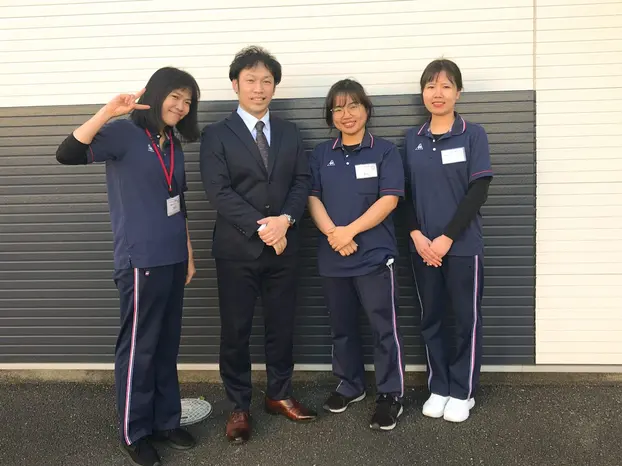
This series follows three Vietnamese women care workers—the “three young women”—who joined Day Service Dandan in Kyoto City (hereafter, “Dandan”) in 2019.
In part 1 of the series, we spoke with Facility Manager Terasaki, who has been involved since the facility’s launch, about the path that led to hiring international talent.
“Our facility first hired international talent in 2015—a woman of Japanese-Filipino descent.
What prompted us to accept international talent was that securing and retaining staff was not going as planned. So we thought, ‘As long as someone has a certain level of care-related knowledge and skills, nationality shouldn’t matter’” (Terasaki; quotations below are also from Terasaki).
An encounter with another provider gave them a push!
A major boost toward starting acceptance, they say, was meeting a nursing care provider in Fukuoka Prefecture that at the time employed about ten Filipino care workers.
“To be honest, we had anxieties about acceptance, but they disappeared all at once when we actually toured the facility.
Seeing the Filipino staff working as full contributing members alongside Japanese staff, we felt, ‘If they can do it, so can we!’”
Responding to globalization also addresses future talent shortages
“I want to keep learning new work.” “I want to become able to do this.” Terasaki believed that with that kind of motivation and drive, someone can succeed as a care worker regardless of nationality.
When actually hiring international talent, Dandan says it has always kept “responding to globalization” in mind.
“Looking ahead, we believe responding to globalization is essential. If we widen the door and keep many options open, we should be able to respond smoothly when talent shortages become a concern.”
What they value in developing international talent
Being able to say “thank you” and “I’m sorry”
What Terasaki says they value most in developing international talent is helping people grow into individuals who can say “thank you” and “I’m sorry.”
“This is a development principle we share with Japanese staff as well, but it may be the thing that seems simplest and is actually the hardest.
We train staff so they grow into people who approach work with sincerity and humility, and always with a positive attitude.”
There are also high expectations of them as pioneers among the facility’s international talent!
“Ultimately, we want them to grow into people who, as seniors, can train and guide the international staff who join later. That is the ideal we have in mind.”
Mental preparation for accepting the three young women
Full-scale hiring for the first time in six years brought two anxieties
Full-scale hiring of international staff at Dandan was the first in six years, since 2014. And they were accepting three people at nearly the same time—were there no anxieties?
“We had two major anxieties. The first was whether frontline staff would accept international talent. And even if we cleared that, we also worried whether service users would accept them.”
Explaining “why international talent, and why now” is essential
For most staff, working with international talent was a first. In that situation, Terasaki took the lead in resolving everyone’s anxieties from the ground up.
“First, we felt we needed to clearly communicate why we had decided to hire international talent.
So in meetings and elsewhere, we made sure everyone understood the reality that securing talent had become difficult.”
They also carefully explained what the Specified Skilled Worker system is.
“It is extremely important that people understand they are not simply ‘foreign workers arriving,’ but joining after acquiring a certain level of care skills and knowledge.”
Building the right mindset with “What if it were you?”
They also held discussions much like image training so staff would have the right mindset for acceptance.
“In meetings and elsewhere, we started by asking people to imagine: ‘If you were working as a care worker abroad, what kinds of difficulties would you face?’
Then we guided them through expected examples one by one, along the lines of, ‘That’s the same for the international talent joining us this time, right?’”
Studying Vietnam’s unique lifestyle habits and culture as well
The three young women scheduled to join at the time were all Vietnamese, so opportunities to learn about Vietnam were also arranged.
“We shared a wide range of information in advance—common personality traits among Vietnamese people, as well as lifestyle habits, religion, favorite foods, culture, and more.
We studied a lot, but even so, after the three joined we were surprised by lifestyle habits we had known nothing about. We’ll cover what those were and how we responded in later Growth Diary installments (laughs).”
Understanding of international talent hiring was gradually built among existing staff, and Terasaki says it took about a month before they felt the acceptance framework—including everyone’s mindset—was in place.
Service users’ reactions were split down the middle…
A mix of curiosity and resistance
Explanations to service users proceeded at the same time.
“About a month before they joined, starting around the hiring interviews, we began explaining that international talent might be coming soon.”
Initial reactions were roughly split half and half between those who accepted the idea smoothly and those who did not.
“Those who accepted included people who knew a Japanese-Filipino staff member had worked there before and said, ‘So this time it’s someone from Vietnam,’ as well as curious people who wanted to talk with someone from another country and learn about that country’s culture.
On the other hand, some felt resistance to being cared for by someone who was not Japanese. For those individuals, we needed to take time explaining and building understanding.”
How do you build a development plan?
Development period: about twice that for Japanese staff
One essential element for utilizing international talent is a development plan. Naturally, a plan different from one for Japanese staff is needed.
“When we began drafting the plan, including how well Japanese would get through, we assumed it would be difficult for them to understand and learn at the same pace as Japanese staff development.”
So they used “about twice that for Japanese staff” as a guideline for the development period.
“For example, the image is training over six months on work that Japanese staff would learn in three months.
It takes a little longer, but because we had previously seen the example of the Fukuoka facility, we thought, ‘In a year, they should grow from zero to standing on their own,’ and built a development plan spanning one full year.”
All staff take part, treating it as their own responsibility
Creating the development plan involved not only the facility manager at the time and Terasaki, then deputy facility manager, but all staff.
“We broke down the skills needed for the job by stage and, together, discussed period-by-period goals such as ‘after one month, we want them to be like this,’ as well as issues and solutions—‘what’s the problem, and what should we do about it?’—as we built the overall plan.
Based on that plan, we then created a training manual.
Listening to Terasaki’s account, what stood out was how important it is for staff to treat this as their own responsibility.
It is frontline staff who actually carry out development and training. Involving everyone from the early stages is likely what ultimately led to the success of the development plan.
Plan steps move from “things” to “people”
First, learning the facility and equipment
And the concrete content of the plan—
“Right after joining, they don’t even know where things are in the facility, so we started by having them get to know our facility and equipment.
Once they had a solid grasp of the “things,” we moved to the next step: learning the staff they work with—the “people.””
Building relationships with service users through daily greetings
After that, they began acquiring communication skills for interacting with service users.
“Duties that require sensitive, direct involvement with service users were held until a certain level of trust with users had been built.
At first we only had them do basic daily communication, such as greetings at arrival and departure. Then we moved to the stage of ‘having service users get to know you more and more.’”
And once they gradually came to know each other, they stepped up to care such as exercise guidance and bathing assistance.
Keys to success in building an acceptance framework
Unify the staff contact point
The development plan was built by all staff. To put it into practice, establishing training leads was essential for creating the right structure and environment.
“Because we planned to assign one person to each of the three sites, we selected one staff member per site in advance to handle on-the-job training on the floor.
And on the three women’s first day, we told them, ‘If anything is difficult or unclear, please ask this person about anything.’”
This unification of the contact point ultimately proved a major success.
“Keeping it simple, I think, gave the three of them peace of mind.”
Same-gender training leads dispel anxiety!
And since all three were women, assigning female staff as trainers worked well too. After all, I think it’s easier to talk about all sorts of things and confide concerns with someone of the same gender.”
Incidentally, deciding on the training leads in advance also had the effect that those individuals played a major, proactive role when the development plan was created.
Building a foundation for daily life with company-leased housing as well
In addition to building systems in the workplace, housing was also prepared to put a proper foundation for daily life in place.
“As was true for these three as well, I think Specified Skilled Worker international talent often relocate from other regions. Our company leased an apartment building and provided it as company housing.
Although they each work at different locations, by having everyone live in the same building, we made it possible for them to communicate with one another and start their jobs with peace of mind.”
―――――――――――――――――――――――――――――――――――――――――
In this installment, we introduced the preparations Dandan made leading up to accepting international talent.
Next time, we will introduce real examples of hiring the “three young women”—reliable Phong, highly charming Toi, and cool-headed Ha. We will also share how their practical skills grew over their first year after joining, as well as Dandan’s specific plans and responses. Please look forward to it!
 Written by

ヤマシタハヤト
Share this article


