SKILLS & APPRENTICESHIPS
From the Study Abroad Boom to Specified Skilled Worker: The State of Japanese Language Schools in Nepal
Among the foreign labor force Japan needs, the employment pipeline for Nepalese talent also plays a major role. Today, among foreign workers holding a status of residence, Nepalese talent is expected to become an increasingly important part of Japan’s workforce, following China, Vietnam, and the Philippines.
Looking at the Immigration Services Agency of Japan’s statistics on foreign residents, the number of Nepalese nationals who entered under the Specified Skilled Worker status of residence as of December 2020 was only 49, showing that acceptance had only just begun and numbers remained small. Compared with Specified Skilled Worker, those holding Student status of residence numbered 24,812—far more—and a trend toward transitioning to Specified Skilled Worker can already be seen among Nepalese international students living in Japan. Specified Skilled Worker has also become a lifeline for Nepalese students who have become stranded in Japan as a result of the “300,000 International Students Plan.”
*The “300,000 International Students Plan” is a policy formulated as part of Japan’s global strategy. It is a government plan established with the goal of hosting 300,000 international students from around the world by 2020.
Background to Nepal’s Study Abroad Boom
When the Japanese government announced the “300,000 International Students Plan” in 2008, it was treated in Nepal as a golden opportunity to go work in Japan. Announcements about the Student status of residence spread via FM radio and every form of media, and applicants and hopefuls poured in.
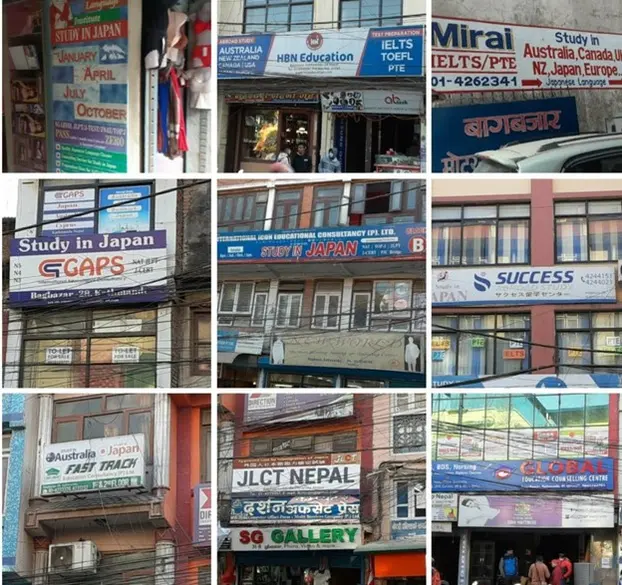
Today, Japanese language schools in Nepal’s capital, Kathmandu, are estimated at roughly 500 or more. Most of them started during that study abroad boom. Some still send international students as before, some send people under other statuses of residence, and some have gone out of business due to the COVID-19 pandemic.
At the time, the pipeline for sending international students was driven by partnerships between Japanese language schools in Nepal and those in Japan. In some respects, this evolved less into running language schools for aspiring students and more into a study-abroad brokerage business fueled by commercial enthusiasm.
Students Recruited to Hit Numbers, and the Subsequent Shift to Specified Skilled Worker
The “300,000 International Students Plan” was effectively achieved before 2020. In 2019, the government newly announced the Specified Skilled Worker status of residence to succeed Student status. Alongside the announcement of this new status, regulations were issued prohibiting international students from working part-time for more than 28 hours, on the premise that they should focus on their studies. As a result of these rules, many Nepalese international students engaged in illegal work, and many received deportation orders from the immigration authority without stated reasons. As the national policy shifted with the achievement of 300,000 international students and began aligning with Specified Skilled Worker, many Nepalese students found it increasingly difficult to make a living in Japanese society.
Regarding local sending under Specified Skilled Worker, the new sending system has not been consistent. At Japanese language schools in Nepal, understanding of Specified Skilled Worker differs from school to school, and with the added impact of the COVID-19 pandemic, the sending pipeline has tended to lag.
The Current State of Japanese Language Schools in Nepal
Now that the study abroad boom has ended and awareness of Specified Skilled Worker is rising in Nepal, media outlets are publishing both praise and criticism as well as issues regarding the aftermath of the “300,000 International Students Plan.” Judging from the current situation of Japanese language schools in Nepal and Japan, Nepalese international students in Japan, and former Nepalese students who have returned home and their families, what they gained from this series of plans appears to have been only temporary satisfaction, not lasting results. Today, challenges continue to pile up on many fronts, extending from issues between the Nepalese and Japanese governments down to the individual level.
That said, in Nepal—where more people hope to find work overseas than domestically—demand for Japanese language schools remains high as essential intermediaries for pursuing employment abroad, including in Japan. Without going through them, it is difficult to pursue overseas job opportunities.
Mindset Reform for All Parties: Lessons from the “300,000 International Students Plan”
The rollout of plans that leveraged the Student status of residence has left people in many quarters living unrewarded lives today. Under the newly established Specified Skilled Worker status of residence, it is hoped that the same kind of casualties as the stranded international students will not be produced.
This requires the maximum possible mindset reform from each stakeholder in their respective roles. To secure an environment in which Nepalese nationals can work in Japan over the long term, advice from Nepalese who have long lived in Japan under statuses such as Permanent Resident and Long-Term Resident will be a key factor and will influence mindset reform among Nepalese working in Japan. (Statuses of residence held by Nepalese residents in Japan: Permanent Resident 5,033; Long-Term Resident 885; Spouse or Child of Japanese National 1,010; Spouse or Child of Permanent Resident 716)
At present, with the added impact of the COVID-19 pandemic, the flow from Nepal to Japan is even more stalled. Even so, Nepalese aiming for overseas destinations including Japan are on the rise compared with those seeking work within Nepal. Facing the flood of applicants hoping to go to Japan, Japanese language schools in Nepal that aim to match candidates with Japan are proceeding by exploring their own approaches in line with each school’s operating methods and principles.
 Written by
Share this article


