ACCEPTANCE & EDUCATION
Specified Skilled Worker Life Orientation: Guidance on Garbage Disposal Rules / An Introduction to Local Waste Practices in Nepal
When hiring Specified Skilled Workers, employers must provide life orientation for foreign nationals. Life orientation includes guidance on garbage disposal rules, an area many foreign residents find difficult.
Because Japan’s garbage disposal rules differ from those in workers’ home countries, and because everyday habits also differ, trouble can arise in the neighborhoods where foreign nationals live. Views on garbage disposal rules vary among foreign residents, but helping them understand and follow the rules in practice will likely require a multi-angled approach to guidance.
As part of that effort, beyond teaching the rules in a manual-style way, it is useful to understand the reasons and background behind why foreign residents may not follow garbage disposal rules, so you can deepen your own understanding.
This article introduces waste disposal practices in Nepal. We hope it will be useful when guiding Nepalese employees.
Nepal’s Waste Management Law
In Nepal, a waste management law was enacted and private-sector waste collection began only a few years ago.
The waste management law sets out detailed garbage disposal rules similar to those in developed countries. Even so, it is expected to take time before private waste operators can run services fully in line with these rules and before the rules take root and are practiced by ordinary residents.
Days When the Garbage Truck Comes
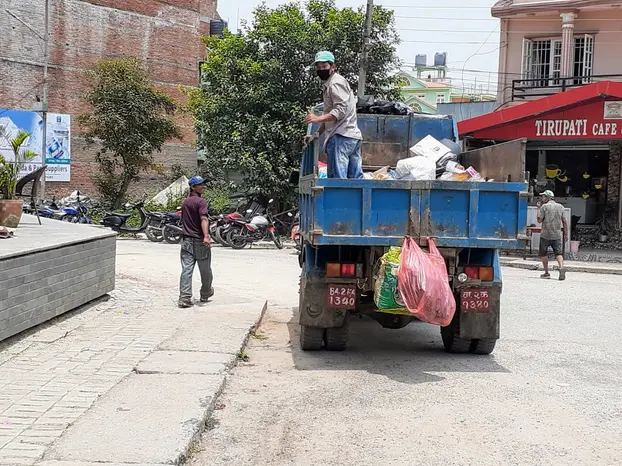
Today in Kathmandu, the capital of Nepal, garbage trucks make rounds on collection days set for each area.
Collection is twice a week. On the days set for each area, and in the early morning hours, workers collect garbage left in front of each home. Collection workers go through residential and commercial streets while blowing a whistle, signaling that collection is underway as they work.
From the start of regular garbage collection until the garbage truck routine became well established, it took about three years in my recollection. Before that, people did not know when workers would come or when they had already come, and there was no fixed place to put out garbage.
At that time, having household waste taken away by the garbage truck was limited to some residents. Others burned household waste in the yard or buried it in the ground.
Rules for Sorting Garbage
Nepal’s garbage sorting rules under the waste management law are not yet strictly mandatory for ordinary residents, so garbage is put out without sorting and collected all together.
Because there are essentially no garbage disposal rules, each household puts garbage out differently. Flyers from waste operators have even been distributed asking people to put garbage out in closed bags or boxes so that workers collecting scattered waste face less of a burden.
Even without detailed sorting rules, problems with how garbage is put out still arise, and some people in Nepal lack what would be considered common sense on this point. Spreading detailed sorting rules to all ordinary residents will therefore require a major shift in residents’ awareness.
Waste Collection Fees
Waste collection companies visit each household once a month to collect fees. The fee is 450 rupees per month, and a receipt signature is entered each month in a collection notebook.
Once a year, only in October during the Dashain festival, residents pay a surcharge as a staff bonus for the waste company employees.
When garbage truck rounds first began, some residents could not adapt right away to a system of paying for waste disposal. Today, however, burning garbage at home draws warnings, so more residents are gradually adapting to the system.
Littering and Piles of Garbage
Along with urbanization in Nepal, the types and volume of discarded waste keep growing, while ordinary residents’ awareness of waste disposal has not kept pace. Many people litter without regard to where they are, vacant lots become dumping grounds, and hygiene problems have emerged.
Garbage often discarded along roadsides includes cigarette butts, empty cigarette packs, candy and gum, and snack wrappers. For these items, littering is treated almost as a matter-of-course habit.
There is little habit of putting garbage in trash bins, and public disposal points are overwhelmingly few, so public spaces only become more cluttered with waste.
Guiding Nepalese people on garbage disposal rules will likely require instruction through educational institutions and legal measures, and it will be a long-term effort.
Nepalese People Are Skilled at Reuse
Gaps in how Nepalese people handle garbage disposal remain a challenge going forward. At the same time, they have a habit of using everyday items for as long as possible and reusing whatever can be used again.
For example, glass jars, empty plastic containers, snack bags, children’s used notebooks, newspaper, empty paint cans, and PET bottles are not thrown away lightly if they can be reused; putting them to a new use is common sense.
Reuse and recycling are not something special for Nepalese people. They do not casually discard things they have been using, and one side of this is that the act of throwing things away is not an established habit.
Separate from waste collection companies, Nepal has a kabadi recycling collection trade that takes unwanted household items in exchange for money. They collect items no longer needed at home, as well as scrap metal, plastics, and rubber goods.
One reason bulky waste is rarely seen among the garbage Nepalese people put out for the garbage truck is that items go to the kabadi, or things no longer used are given or sold to others rather than thrown away.
Summary
Japan’s garbage disposal rules often strike foreign nationals with different habits and cultures as strict.
For foreign nationals to engage seriously with Japan’s garbage disposal rules, it will also be necessary—before teaching a how-to manual—to gradually unpack their thinking and awareness around waste disposal, and to understand the garbage disposal practices of each country.
 Written by
Share this article


