CULTURE & LIVING ABROAD
Nepalese Food Culture and Dining Manners | Dal Bhat, Eating with Hands, and Religious Dietary Taboos
Ideally, the cultural gaps that foreign nationals working in Japan experience will become a positive influence over time.
One of the first cross-cultural experiences people have after moving abroad is food they have never tasted before. Japanese cuisine is characteristically milder and less spicy than many other Asian cuisines. For foreign nationals from countries with food cultures very different from Japan’s, it can take time to get used to Japan’s distinctive meals.
At some overseas construction sites where multinational engineers gather, and at overseas branches of major companies, employers hire cooks from various countries so people can eat the food of their home countries.
In the workplaces where technical intern trainees and Specified Skilled Worker foreign nationals work in Japan, support for daily meals rarely extends that far. Even so, taking an interest in overseas food cultures can be an important way to communicate with foreign employees.
This time, among foreign nationals working in Japan, we introduce the food culture and customary manners of Nepal, a nationality expected to grow further going forward. Even among Nepalese people, religious outlook and everyday manners vary from person to person. Some become freer in how they act once they leave Nepal, while others want to maintain Nepalese customs and manners even while living abroad.
When employing Nepalese people, it helps to respond flexibly to each person’s habits.
Nepalese food culture
Nepalese food culture is strongly influenced by neighboring Indian, Chinese, and Tibetan cuisines, and within Nepal people can enjoy a multinational range of dishes.
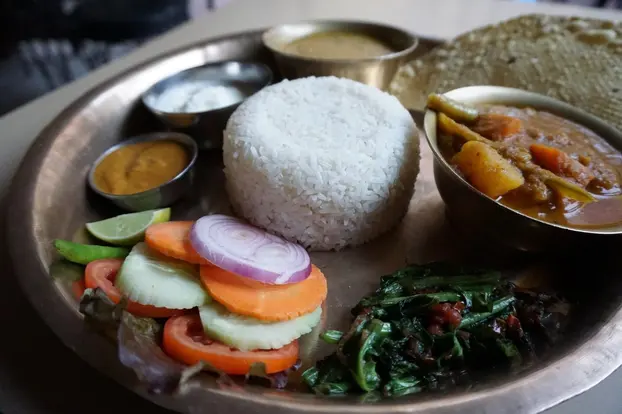
Even in food-rich Nepal, the dish ordinary people most prefer and eat every day is “dal bhat tarkari”. Nepal’s national dish, dal bhat tarkari, uses fewer spices than Indian cuisine and features many healthy menus rich in vegetables, making it relatively easy for Japanese palates to enjoy as well.
Nepal is also a multiethnic country, so ethnic cuisines vary widely. Representative examples include Thakali cuisine and Newar cuisine. Among Nepal’s ethnic cuisines, these two stand out for their ingredients and seasoning, and both are popular with ordinary people across the country.
Everyday eating habits of Nepalese people
A typical Nepalese meal routine is a light morning bite, breakfast, a snack, and dinner.
The light morning bite often includes Nepali tea (milk tea with plenty of sugar and milk) with biscuits or bread. Main meals are usually twice a day, consisting of dal bhat tarkari. Snacks vary by household; typical examples include fried sweet sweets, chow mein (fried noodles), and chiura (flattened rice flakes) with a spiced side dish.
Typical meal times are a light bite on waking, breakfast around 10 a.m., a snack around 3 p.m., and dinner after 7 p.m. Depending on the household, times shift to fit family work or school schedules, and some people eat only two meals a day.
“Dal bhat tarkari”
Nepal’s national dish is called “dal bhat tarkari.”
The name means dal (lentil soup), bhat (cooked rice), and tarkari (vegetable side dishes).
Dal is a nutritious protein-rich soup essential to the Nepalese family table. More than 50% of Nepal’s population has a rice-centered food culture and is used to eating large amounts of rice. Depending on the variety, rice can be bought for around 70 rupees per kilogram.
Tarkari is a vegetable side dish stir-fried with spices. It is typically cooked with plenty of oil and green or red chilies for a spicy seasoning.
Dal bhat tarkari is always accompanied by achar, a sour and spicy pickle, and yogurt, egg dishes, or meat dishes may also be added to the table.
With the growing number of Nepalese residents in Japan, restaurants serving Nepalese food close to local flavors have been increasing. In Tokyo’s Shin-Okubo, known as Little Nepal, you can obtain Nepalese ingredients and find places that serve dal bhat tarkari at affordable prices. Shin-Okubo Street is said to expand Nepalese networks, and it has become a hub for information on food, clothing, and daily life.
Eating with the hands: Hindu dining etiquette
Nepalese people eat by skillfully using the fingers and palm of the right hand.
The hand-eating culture common across parts of Africa, the Middle East, India, and Southeast Asia is often seen as poor manners because of cultural differences. In Nepal, however, people carefully wash their hands before meals and eat with their own clean hands, so hygiene is maintained. It is Nepalese custom to wash hands before a meal at a sink separate from the one used to wash dishes afterward. Using the same sink is considered unhygienic and impure.
As pre-meal etiquette, there is a custom of taking a small portion of the food served on the plate, placing it on the table, and performing a brief prayer before eating.
In Nepal, people do not share food, drinks, or plates that someone else has already touched. They do not take side dishes from a shared large platter on the table. Dal bhat tarkari is eaten from dishes plated one plate per person.
When someone wants a second helping, a server waiting in the kitchen, or a woman in the family, usually handles the serving.
Women often handle cooking at home, but women who are menstruating are not allowed into the kitchen, so during that period someone else in the family does the cooking.
Lower castes and meals
The caste system (hierarchical social status system) has been abolished by law, but reality is different. In Nepal, where older social customs still remain, people are often made conscious of caste in daily life, and among Nepalese people, relationships that take caste into account are practiced as an unspoken norm.
Regarding meals as well, the custom of not eating together with people of lower castes still remains, and relationships with lower-caste people may need to be managed with clear boundaries.
Dietary restrictions on religious observance days
Many ethnic groups in Nepal primarily revere Hinduism, and devout believers may be vegetarians who do not eat meat or fish. On religious observance days, people may also refrain from eating, bathe, and only take a meal after a series of rites is complete.
There are also dietary restrictions and limits on behavior when a relative has died or on memorial days, so when guests visit, people first ask about meals before offering hospitality.
Summary
Nepalese food culture includes many forms of etiquette different from Japanese manners, with distinctive customs aligned with religious practice. In Nepalese society, where multinational foreign nationals and many ethnic groups live side by side, diverse cultures coexist beyond food alone.
For those considering hiring international talent
As a Registered Support Organization, YourBright provides international talent placement services centered on the Specified Skilled Worker program. Hear from companies that have accepted workers in our case studies, and find materials useful for acceptance preparation on our downloads page.
 Written by
Share this article


