CULTURE & LIVING ABROAD
In Vietnam, 9 Is a Lucky Number! What Are the Lucky Colors and Taboos?
When you enter a Vietnamese eatery, you will almost always find offerings displayed at the entrance for the “god of commerce.” It is also a Vietnamese tradition to prepare food offerings for the household “kitchen god” ahead of Tet, the Lunar New Year. Influenced in part by Taoism, a Chinese folk belief, Vietnamese people place great importance on auspicious symbols and taboos. Here we introduce what is considered lucky in Vietnam, along with related taboos.
Lucky symbols in Vietnam ①: The yellow-and-red combination
Vietnamese people tend to choose gifts, decorations, and foods with auspicious colors in mind, especially around the Lunar New Year.
During Tet, yellow and red decorations are everywhere
When Tet approaches, shops are packed with Tet decorations. The colors are fixed: almost all are combinations of yellow (or gold) and red. Especially eye-catching are the yellow flower decorations. They are called “plum blossoms,” but the actual flower is hoa mai, which is completely different from plum. Plum and peach blossoms are traditionally considered auspicious, but because they are hard to obtain in season, it has become customary to display hoa mai instead.
Gifts in auspicious colors are preferred
At Tet there is a custom of giving presents to people who have helped you, and auspicious colors are emphasized then as well. Sake, for example, is a popular Tet gift, but stylish packaging based on black or silver is often avoided as inauspicious. Some Vietnamese people will buy unfamiliar Japanese products simply because the packaging uses lucky colors. From a Japanese perspective, the packaging that draws the most popularity can look flashy or “gaudy and gold-plated.”
Lucky symbols in Vietnam ②: Numbers—and absolute taboos
Lucky colors are especially important at Tet, but numbers are something Vietnamese people mind for good luck in everyday life.
In Vietnam, the lucky numbers are 9 and 8
The number Vietnamese people consider most auspicious is 9. On motorcycle and car license plates, numbers that add up to 9 are seen as lucky. Phone numbers and lottery tickets tend to be chosen by the same standard. Nine is said to be considered lucky under Chinese influence. In Sino-Vietnamese, 9 is pronounced “cửu,” the same pronunciation as the word for eternity. From that, 9 is seen as a number that brings everlasting happiness. Merchants also treat 8 as a lucky number because its pronunciation evokes prosperity.
Taboo numbers in Vietnam are 3 and 7
The number considered taboo in Vietnam is 3. It is said to imply misfortune, and some Vietnamese people avoid going out on days that include 3, or dislike having three people stand side by side for a photo. Buildings may also create two floors labeled A and B for the 12th floor to avoid displaying a 13th floor. Seven, which is considered a lucky number in Japan, is also taboo. In Vietnamese, 7 is pronounced “thất,” which evokes “thất bại,” meaning failure. The famous Vietnamese beer “333” may look inauspicious at first glance, but because the digits add up to 9, it is considered to bring good luck.
Lucky symbols in Vietnam ③: Five kinds of fruit
Many kinds of fruit are eaten in Vietnam, but five are considered especially auspicious.
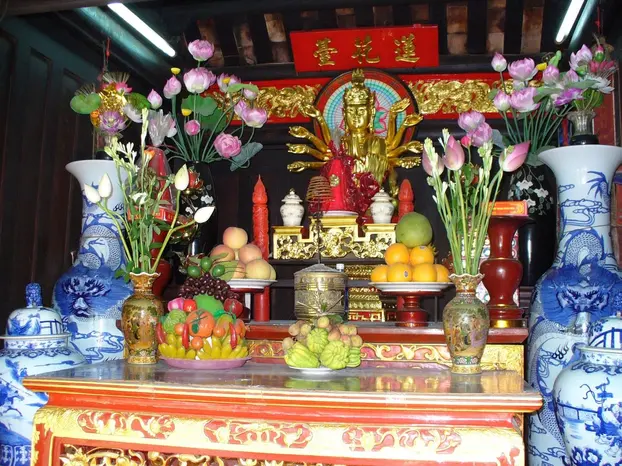
The large offering plate is a showcase of lucky items
At Lunar New Year, fruit offered to the “kitchen god” is arranged on a large plate called mâm ngũ quả. Mâm means tray, ngũ means the number five, and quả means fruit. Although we introduced 9 and 8 as lucky numbers, five was once considered an auspicious number. The five fruits are traditionally composed in five colors: black for water, red for fire, green for wood, white for metal, and yellow for earth. Red includes watermelon or dragon fruit; green includes unripe bananas or papaya; white includes pears; yellow includes pomelo or oranges; and black includes mangosteen or rambutan.
Fruits that evoke the image of the Buddha
Vietnam is a Buddhist country. For that reason, people actively offer fruits that evoke the image of the Buddha. One is phật thủ (Buddha’s hand). It is an unusual citrus fruit that can look like a flower, a pumpkin, or a banana. Although it is a citrus, it is almost entirely peel. It is slowly boiled in hot water and eaten. Another is shaka-tō (Buddha’s head), also known in Japan as custard apple. The white flesh is very sweet, with a mild tartness as well. As the name suggests, its appearance recalls the head of the Buddha, so it is considered an auspicious fruit. Both can be easily purchased at street stalls and similar places.
Summary
Some Vietnamese people arrange their rooms according to feng shui teachings to avoid taboos, or refrain from eating meat for religious reasons. In Vietnam, this is not treated as something special—it is accepted as ordinary. When someone acts with auspicious symbols or taboos in mind, respecting that as much as possible will be important for building good relationships with Vietnamese people.
 Written by
Share this article


