CULTURE & LIVING ABROAD
The Appeal of Nepal: Introducing Four World Heritage Sites!
Nepal, a small country in South Asia.
An inland country stretching east–west around the capital, Kathmandu, Nepal has the China border region lined with the Himalayas, while along the India border stretch the hot, humid Terai plains.
Tourists and medium-term visitors from around the world come to the climatically distinct south and north. Drawn by the beautiful scenery and the simple, natural character of the Nepali people who live there, many return to Nepal again and again.
The real joy of travel in Nepal lies in its striking scenery and easygoing exchanges with the people who live there.
More than 50 ethnic groups live side by side in Nepal. In each of the four regions selected as World Heritage sites, communities centered on different ethnic groups offer a chance to experience local ways of life and culture rooted in the area.
Four World Heritage Sites in Nepal
Nepal’s UNESCO World Heritage sites are Sagarmatha National Park / the Kathmandu Valley / Lumbini, the birthplace of the Buddha / Chitwan National Park. All are popular with both local visitors and overseas tourists, and each is a compelling place worth visiting at least once.
A World Heritage tour lets you enjoy impressive landscapes and activities—untouched nature, historic architecture, places shaped by religious culture, and lush forest areas home to wildlife.
Breathtaking Panoramas at Sagarmatha National Park
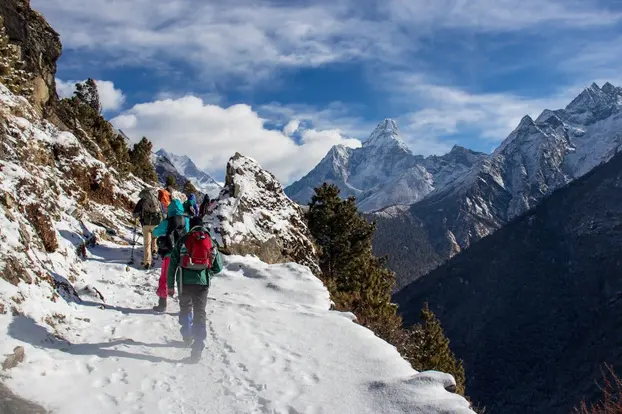
Located in the Himalayas, home to Mount Everest, the world’s highest peak, is Sagarmatha National Park.
Rare animals and alpine plants live in this vast natural setting, and the park offers not only serious mountaineering but also trekking courses beginners can enjoy.
Access to Sagarmatha National Park is from Kathmandu to Lukla Airport, then on foot into the Khumbu region, where the park is located. Namche Bazaar, the largest settlement in Khumbu, is commonly called a Sherpa village—an area at 3,440 m where the Sherpa people, mountain guides, live. Mountaineering enthusiasts use Namche Bazaar as a gateway to the peaks.
There are two main routes in Sagarmatha National Park: from the Sherpa settlement of Namche Bazaar to base camp and Kala Patthar, and from Namche Bazaar to Gokyo Peak. There are also domestic tour plans for a “mountain flight” that offers aerial views of Everest, the park’s highest peak.
(Sagarmatha means Himalaya in Nepali.)
Historic Streetscapes of the Kathmandu Valley
Newar culture is centered in the Kathmandu Valley, which long flourished as a trading hub for merchants from India and Tibet. It is a region of religious culture where Hinduism and Buddhism coexist, and where many ethnic groups live.
The indigenous people of the Kathmandu Valley, the Newar, are known for outstanding talent across many fields, including architecture, sculpture, religion, language, food, music, dance, and literature.
The Kathmandu Valley has three main cities—Kathmandu, Patan, and Bhaktapur. Their cityscapes evoke an earlier era, with streets of brick and wood-carved Newar architecture and everyday scenes of ordinary Nepali life that visitors often want to capture on camera.
Each major city has a Durbar Square with former royal palace buildings and Hindu temples. The Kumari Ghar, home to a young girl venerated as the living embodiment of the goddess Kumari, and Bhaktapur’s Durbar Square—also used as a film location—offer beautiful scenes that seem to transcend time.
Travelers in Asia often spend time in Kathmandu as a stop along the way, crossing the land border into neighboring India, continuing to Tibet or China, which have influenced Nepali culture, or enjoying the great outdoors through Himalayan mountaineering. From Kathmandu as a base, many kinds of journeys are possible.
Lumbini, a Sacred Site of Buddhism
Pilgrims and tourists from around the world visit Lumbini, the birthplace of the Buddha. You can tour Buddhist temples from many countries and experience the origins of the Buddha’s birth beneath the large bodhi tree associated with his enlightenment.
Lumbini is one of the eight great sacred sites of Buddhism; the other seven are in India. Pilgrims from India can cross the border from the border town of Bhairahawa to reach Lumbini. From Kathmandu, you can travel to Bhairahawa by plane or long-distance bus.
Around Lumbini, ordinary Hindu residents live as well, offering a glimpse of everyday life apart from the Buddhist sacred site.
From Lumbini, you can reach Chitwan in about two hours, also in the Terai region.
Subtropical Jungle at Chitwan National Park
On the Terai plains near the Nepal–India border lies a vast subtropical jungle home to wildlife: Chitwan National Park. Stretching about 80 km east–west and 23 km north–south, the park is habitat for rare, endangered wild animals such as Bengal tigers and Indian rhinoceroses.
Ways to enjoy Chitwan National Park include elephant safaris through the jungle, canoe trips on the river where you may encounter crocodiles and beautiful birds, and jungle walks. There are many tours that let you explore deep into the forest.
Near Chitwan National Park is the Tharu village of Sauraha, where you can see traditional Tharu mud-walled houses and distinctive ways of life. In the evening you can watch Tharu folk dance performances. It is a place to enjoy both ethnic discovery and the natural world.
In Summary
In multiethnic Nepal, strongly influenced by India and China, simply traveling within the country brings encounters with many peoples and cultural experiences. Visiting the World Heritage sites makes for a journey that fully showcases Nepal’s nature and multicultural character.
 Written by
Share this article


