CULTURE & LIVING ABROAD
Different Places, Different Norms: A Look at Construction Sites in Nepal
Looking at construction sites in Nepal reveals all kinds of surprising scenes.
When the place changes, so do the norms.
This time, let us share a few episodes from construction sites in Nepal.
Foot safety
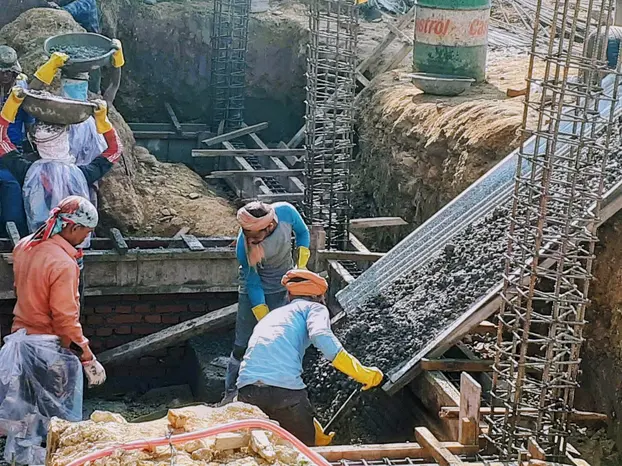
On construction sites, it is perfectly ordinary to see craftspeople working in sandals.
Because they wear sandals on their feet, there is naturally no requirement to wear helmets, no designated workwear, and people simply work in whatever clothes they prefer.
At times, some craftspeople even show up in black leather shoes that make you want to ask, “Are those really the right shoes for this?”
No one points out that safer footwear would be better on a construction site, and there is no guidance from site supervisors either. Construction sites with craftspeople in sandals simply function without any sense that something is out of place.
Many of the people working on construction sites in Nepal come from economically poor backgrounds. On sites where footwear wears out quickly, a simple reason is that it is cheaper and less of a burden to wear and discard sandals that cost about 200 rupees a pair.
Nepal’s construction industry is still a classic 3K sector as well, and the craftspeople who work there seem to want, at least when it comes to protecting their feet and bodies, to work freely and with peace of mind in the style they are used to.
Working in Nepal’s construction industry without the protection of national laws or company labor standards, these craftspeople have no guarantees or support beyond the present moment, and they work freely in sandals.
Bamboo scaffolding is fine
Scaffolding on construction sites in Nepal is built by lashing bamboo together with rope. Similar scaffolding is used in China and Southeast Asia as well, and the bamboo scaffolding on high-rise buildings in Hong Kong is especially well known.
Put simply, the method is to set bamboo poles vertically and horizontally in a grid, then tie the points where the bamboo crosses with rope.
Even for buildings three or four stories above ground, bamboo scaffolding is put up in the same way and used for exterior work.
Even for work at height, there are no safety measures such as helmets or lifelines, and the work proceeds as people move skillfully across the bamboo.
Low cost is one reason, and when it comes to assembly and dismantling afterward, bamboo is also lighter and easier to handle than steel pipe.
In Nepal there is no specialized trade equivalent to scaffolders (tobishoku). Painters, plasterers, bricklayers, rebar workers, and every other craftsperson who works at height all use this bamboo scaffolding to do their jobs.
Working hours that stop short of overwork
Winter mornings in Nepal are harsh. Amid white morning mist, site work begins from 6:00 a.m.
Around 10:00 a.m., the temperature rises sharply, and craftspeople each take a one-hour break, heading to a cafeteria for breakfast or eating a boxed lunch on site. It is also common to see wives delivering lunch every day to craftspeople who live near the site.
Winters in Nepal bring sharp cold in the morning and evening, but when the sun is out during the day it is a comfortable season with temperatures around 20°C.
After the 10:00 a.m. breakfast, work resumes; there is a one-hour snack break at 2:00 p.m., and then work continues until 6:00 p.m.. At times, remaining work continues late into the night.
Daily working hours are 10 hours plus overtime. Days off within a week vary with the site schedule, so people sometimes work straight through weekends as well.
Compared with Japan’s Labor Standards Act, daily hours tend to run quite long. For Nepalis, however, most people on a given site are short-term workers, and they rest before the strain builds up or take time off while moving to another construction site, so it does not seem to turn into overwork.
Working patterns also differ between employees of contracting companies and freelance craftspeople.
On construction sites in Nepal, where work rules and manuals are not formalized, rules on working hours are also loose.
Women on construction sites
Women’s main jobs on construction sites are carrying materials and cleaning. Bricks, gravel, sand, stone, and the like are packed into back baskets and carried. Married women with children juggle housework and childcare with hard physical labor on the construction site.
Some mothers even bring young children to the site and let them play while they work.
As a custom in Nepal, housework is often considered a woman’s role, and you hear people lament how hard it is to come home after physical labor from early morning to evening and then prepare meals.
Pay is also set so that women’s wages are lower than men’s, and working on a construction site can be called a risky occupation for women.
With Nepal’s ongoing construction boom, jobs on construction sites tend to be relatively easy to find for both men and women, and some Nepali couples work on the same site together.
Concrete pouring work
Residential buildings in Nepal commonly use a brick masonry wall reinforced concrete structure, typically three to five stories above ground. Combining brick and reinforced concrete is often seen in developing countries, though there appear to be various issues with earthquake resistance.
In concrete pouring work, smaller jobs are often done by hand: ready-mixed concrete stirred with shovels is piled onto trays by multiple craftspeople and carried in a bucket-brigade style to build the structural frame. On larger sites, only the mixing of ready-mix is done with machinery rather than by hand; the rest of the work is still carried out in the same bucket-brigade fashion.
Even after an earthquake…
The Nepal earthquake of April 2015 caused extensive damage and raised the issue of seismic resistance in Nepali buildings, yet those lessons have not been much reflected in current construction methods.
Ordinary Nepalis who are not especially familiar with construction in particular seem to have little interest in earthquake resistance.
In the rainy season of 2021 as well, rainfall was heavy, and homes built on loose ground saw many flood-related problems. Here too, ordinary people’s response was entirely business as usual: after retaining walls collapsed in landslides, they simply rebuilt the same kind of walls without any shoring, leaving little room for people with specialized building expertise to step in.
Nepal does have universities specializing in architecture and experts who studied overseas, but the gap with ordinary people and craftspeople on construction sites is large, and practice rarely reaches high-quality construction methods.
In closing
When the place changes, so do the norms of safety and construction methods on Nepal’s building sites. Labor standards are loose, and site management varies with how contracting companies run the work, the client’s wishes, and the craftspeople on site. Everything proceeds under relaxed rules.
The way craftspeople work on these sites may look short on safety, but in practice few people get injured, and they work in a sturdy, powerful, free-spirited way.
 Written by
Share this article


