CULTURE & LIVING ABROAD
Vietnam’s Elementary Schools and School System | A Clear Guide to Classes, Grades, and Differences from Japan
Quick answer: How does Vietnam’s school system differ from Japan’s?
Vietnam’s schools basically follow a 12-year system: five years of elementary school, four years of lower secondary school, and three years of upper secondary school. When hiring, do not mechanically map these to Japanese grade levels; instead, verify the original diploma, school name, and period of enrollment to reduce oversights in educational background.
Vietnam’s school system is broadly similar to Japan’s, but there are some differences, such as the length of compulsory education. In Vietnam, primary and secondary education begins at age six. Compulsory education lasts nine years in total—five years of elementary school and four years of lower secondary school—and those who continue attend upper secondary school for three years. There is an education gap between urban and rural areas in Vietnam, and because even public schools are not free of charge, only some children living in urban areas can advance to upper secondary school.
Vietnam’s school system (1): Shortage of educational facilities is a challenge
Vietnam’s compulsory education period is nine years, from elementary school enrollment through lower secondary school graduation. The grade system is continuous, consisting of Grades 1 through 9.
In urban areas, students attend in morning and afternoon shifts
The school year in Vietnam begins in September. The first semester runs until late January, around Lunar New Year after the turn of the year. The second semester then continues through June. July and August are summer vacation, when temperatures can become extremely hot. Children in poor areas such as rural regions often end their schooling after Grade 5, when the elementary curriculum finishes, and begin working to support their household.
In urban areas, population concentration means elementary and lower secondary schools cannot accommodate all children. Moreover, because there is no school-district system like Japan’s, students flock to popular schools. Pupils attend in morning and afternoon shifts, yet class sizes still exceed 50. Teachers are in short supply, and finely tailored instruction is not provided.
More Vietnamese families are also emphasizing Japanese language study
In urban areas such as Hanoi, Hai Phong, and Ho Chi Minh City, some lower and upper secondary schools offer classes where students can learn Japanese. Japanese classes are highly popular and only Vietnamese students with a certain academic ability can enroll. However, the quality of Vietnamese Japanese-language teachers varies, and students who have lived in Japan are sometimes more proficient in Japanese. For that reason, many Vietnamese also attend Japanese language schools with Japanese teachers after regular school hours.
Vietnam’s school system (2): Elementary school starts earlier than in Japan
In Vietnam, children who turn six by December of that year are eligible to enter elementary school. The enrollment date is generally September 5. Unlike in Japan, therefore, some children become elementary school students at age five.
Montessori education is popular in kindergartens
Because dual-income households are common in Vietnam, more children are attending kindergarten. About 60% are public and 40% private. Many private kindergartens promote Montessori education and feature a colorful, charming atmosphere compared with the often plain buildings of elementary and lower secondary schools. Children can attend kindergarten between ages three and six.
Elementary school may start as early as 7 a.m.
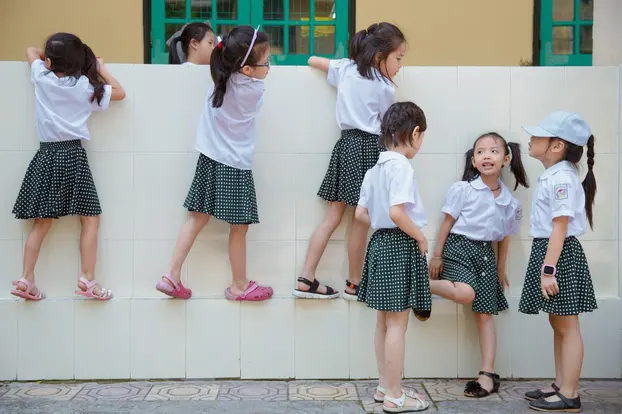
Outside the gates of Vietnamese elementary schools, large numbers of motorbikes crowd the area from about 7 to 8 a.m. Because students are split into morning and afternoon groups, the school day starts earlier than in Japan. Many children do not have time to eat breakfast at home, so numerous food stalls selling breakfast appear around the school gates before classes begin. Around 5 p.m., when school ends, stalls selling snacks that appeal to children also appear.
Required subjects in Vietnamese elementary schools include Vietnamese language, foreign language (mainly English), mathematics, nature, history and geography, science, physical education, arts, ethics, life skills, and information technology. Particular emphasis is placed on foreign language and IT education. Computer-related subjects begin in Grade 3, and students learn programming languages from an early age. Because daytime temperatures become extreme, there is about a two-hour “nap” period.
Vietnam’s school system (3): Secondary education is split into lower and upper secondary
Secondary education in Vietnam is divided into two stages: the lower stage corresponds to lower secondary school, and the upper stage to upper secondary school. Compulsory education extends through lower secondary education.
Lower secondary education lasts four years, from Grade 6 to Grade 9
Lower secondary school covers four years from Grade 6 to Grade 9. Compared with Japan, elementary school is one year shorter and lower secondary school is one year longer. Required subjects include literature, mathematics, foreign language, history and geography, natural sciences, physical education, and the arts, plus civic education, technology, and information education.
Many Vietnamese children excel at mathematics and regularly place highly in the International Mathematical Olympiad. The mathematics curriculum often seems more advanced than Japan’s. While some children attend cram schools aiming for higher education, others begin vocational training with an eye toward life after graduation.
A national examination is held at upper secondary school graduation
Upper secondary school in Vietnam lasts three years, from Grade 10 to Grade 12. Both public and private schools exist, and both administer entrance examinations. There is also an examination before graduation, positioned as a national exam that doubles as a university entrance exam. In the past, failing the graduation exam meant being treated as a lower secondary graduate, but completion certificates are now issued.
Required subjects in upper secondary school include literature, mathematics, a first foreign language, economics and law, history, geography, physics, chemistry, biology, and the arts. Applied education is also offered in areas such as information technology, design technology, and national security. Students may also choose a second foreign language, extracurricular activities, and vocational training. Students with greater financial means go on to universities in Vietnam or abroad.
Summary
Because advancement rates in Vietnam are closely tied to economic disparities, not having attended upper secondary school or university does not necessarily mean lower academic ability or motivation. Some people work and save money, then enter university or vocational school in their late twenties, or study abroad in Japan. When considering hiring Vietnamese talent, therefore, we recommend assessing suitability in light of each individual’s circumstances.
Points to watch when verifying educational background at hiring
Differences in school systems also affect the education section of résumés and explanations given in interviews. To deepen your understanding of candidates, also see Cultural differences to know when hiring Vietnamese talent.
For those considering hiring international talent
As a Registered Support Organization, YourBright provides international talent placement services centered on the Specified Skilled Worker program. Hear from companies that have actually accepted workers in our case studies, and find materials useful for acceptance preparation via document downloads.
 Written by
Share this article


