CULTURE & LIVING ABROAD
8 Rare Fruits You Can Eat in Vietnam
Vietnam is full of unusual fruits that are rarely available in Japan, sold as everyday items. Some fruits classified as premium are even sold by street vendors and peddlers at surprisingly low prices. For fruit lovers, Vietnam is practically paradise in how well stocked it is. Here are six unusual fruits you should definitely try when you visit Vietnam.
“Smelly but delicious” is a hallmark of Vietnamese fruit
One hallmark of fruits eaten across Southeast Asia, including Vietnam, is that they are “smelly but delicious.” You might even say the subtle odor becomes addictive.
Durian divides opinion even among Vietnamese people
When people say what you must eat in Vietnam, durian always comes up. Durian is sold throughout Vietnam, but it is especially widely eaten in the south, including Ho Chi Minh City. Some shops pile durian high in their garages and sell it at bargain prices. Durian is said to be “smelly,” but the unpleasant odor comes from declining freshness. Fresh durian tastes like creamy custard and is not as smelly as people say. That said, it has a distinctive flavor, so opinions are split even among Vietnamese people.
Jackfruit has about half the smell
If you would rather skip durian, try jackfruit. Jackfruit is even rarer in Japan than durian, so it is worth trying at least once. It has a rich flavor somewhere between pineapple and banana, with a creamy character. Jackfruit seeds turn into fluffy, slightly sweet beans when boiled. Thanks in part to the lifting of import restrictions, it has become available in Japan as well, so give it a try if you get the chance.
In Vietnam, you can stock up on ultra-premium fruit!
In Vietnam, unusual ultra-premium fruits that would be out of reach in Japan are sold in large quantities, so it is a chance to buy them in bulk.
Mangosteen is sold by weight, so bulk buying is easy
While durian is called the “king of fruits,” mangosteen is called the “queen of fruits.” Even this premium fruit, mangosteen, can be bought in bulk at low prices in Vietnam. The rind looks hard at first glance, but it is surprisingly soft and easy to peel by hand. The white flesh inside has a refined flavor with a subtle tartness. During the harvest season from around June to August, you can sometimes get it for about 400 yen per kilogram when prices are low. Freshness drops sharply once the season ends, so enjoy it during the season if you can.
Dragon fruit can be enjoyed year-round
Dragon fruit is a fruit you can casually enjoy year-round. Recently, Vietnamese dragon fruit has been stocked at major Japanese supermarkets, but it can cost nearly 400 yen each, so it is not exactly an everyday purchase. Although dragon fruit is considered unusual in Japan, in Vietnam, where it is grown, it is available anytime. Local supermarkets sell it pre-cut, so you can easily enjoy it at your hotel.
Vietnam also has many unusual fruits with striking appearances
Another hallmark of Vietnamese fruit is that fruits that at first glance look “too weird to eat” often turn out to be surprisingly delicious.
Rambutan: looks like a hedgehog
Rambutan is an unusual fruit you rarely see in Japan. The skin is greenish red with hedgehog-like spines (though they are soft, so they do not hurt). Many people have tried lychee, and the flavor goes in a similar direction. The seed is large and the fruit is a bit of an acquired taste, so it is sold much more cheaply than lychee. Suck the flesh off the seed in your mouth and you can fully enjoy the sweet juice.
Sugar apple: looks like a knobby head
Sugar apple is a classic fruit for offerings. As the name it is sold under in Taiwan, “釋迦頭,” suggests, it has a knobby appearance reminiscent of the Buddha’s head. Sugar apple’s defining trait is its intense sweetness. Some people may find it too sweet. Because it is highly nutritious, it is often grown at temples and serves as a valuable source of nutrition for monks who abstain from meat.
Unsweet fruits are also characteristically Vietnamese
In Vietnam, fruit is not always sweet. Quite a few have a refreshing taste that makes you wonder, “Is this really fruit?”
Pair star fruit with spiced salt
Star fruit is one of the fruits that feel characteristically Vietnamese. It looks green and may resemble a bell pepper or a thick leaf, but it is a genuine fruit. At about 200 yen per kilogram, it is extremely cheap. It has almost no sweetness, but its crisp texture becomes addictive. The recommended way to eat it is like a snack, dipped in a spicy spiced salt.
Green mango also needs spiced salt
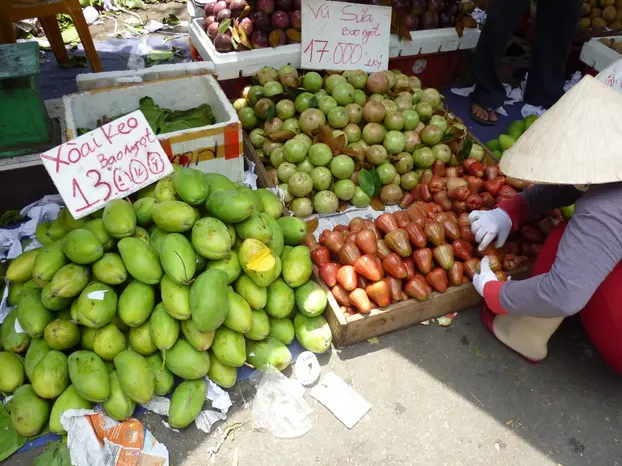
If you live in Vietnam, mango is an everyday fruit. Some are yellow and ripe like Japanese mangoes, but Vietnamese people tend to prefer tart green mango. Eaten plain, it is hard and sour, so it hardly feels like fruit. Dip it in spiced salt and, strangely, the sweetness comes out and you cannot stop eating.
Conclusion
Vietnam is a treasure trove of unusual fruits you will not see in Japan, but Vietnamese and Japanese people have quite different senses of what fruit should be. Some may not suit your taste—smelly, sour, hard, or too sweet. Local supermarkets sometimes sell them in small portions, so we recommend trying a small sample first.
 Written by
Share this article


