CULTURE & LIVING ABROAD
Surprising Facts! What Transportation in Nepal Is Really Like
This article introduces transportation in Nepal.
Because Nepal’s transportation systems have no automation, operations continue to rely on manpower. Rather than becoming more convenient and comfortable through automation, Nepal still retains a style in which people depend on other people to make work and daily life possible.
The transportation options available in Nepal are buses, taxis, and tempos (auto rickshaws).
Privately owned motorcycles are widely popular in Nepal for easy mobility, but public transportation also remains an essential means of getting around for ordinary people.
Nepal’s Buses That Rely on Manpower
In Nepal’s capital, Kathmandu, there is a ring road that circles the city, known as the Ring Road. Inside the Ring Road is the city center, and outside are suburban residential areas.
Bus routes include a loop around the Ring Road as well as routes between the city center and the suburbs, running toward various parts of Kathmandu.
Bus fares are 15–25 rupees per ride. There is no timetable, but service is frequent enough that this is not a problem. Buses run from about 6:00 a.m. to around 7:00 p.m., and they get crowded during the morning and evening commute and school rush.
Boarding and alighting take time because there is no custom of people yielding to one another at the exit. Bus doors are generally left open, and during crowded times it is common for passengers to hang out over the side while the bus is moving—revealing the Nepali trait of using any means necessary to get around.
Fares are paid by handing cash directly to the khalasi (conductor) when getting off the bus. There is no fare box, no change-making equipment, and of course no dedicated IC card.
There is no stop button, so the khalasi (conductor) shouts out the names of the stops. When you shout back “Getting off!” the bus will stop.
Nepali buses have no automated features and everything is done by manpower. The system works because the khalasi (conductor) manages passengers and handles fares.
As for boarding manners, there are women-only seats, and when elderly people or children board, there is a natural habit of giving up one’s seat. No one minds if people talk loudly inside the bus, and no one complains that loud music is annoying. It is also normal for the bus to stop at a gas station with passengers still on board when it runs out of fuel.
The cabin environment has no air conditioning, windows and doors are left open, seats sometimes slide out of place, all kinds of people ride, cargo is sometimes carried alone, and the buses are neither clean nor new. You might not call this comfortable, but once you get used to it, it becomes a convenient means of transportation.
Nepal’s Taxis, Where You Ride After Negotiating the Fare
Nepali taxis used to be mostly older models, but today Indian-made Maruti Suzuki vehicles are the most common on the road. They are maneuverable and can enter any alley, so they will take you reliably to your destination.
Riding a taxi begins with negotiating the fare. Although meters are installed, drivers usually will not use them, citing reasons such as the meter being broken. Because fares are negotiated, the price varies by driver.
If you want to set the fare clearly before riding, you can also call a taxi through a ride-hailing app. Foreigners are often overcharged, so knowing the going rate makes negotiation easier.
Seat belt use is required under traffic rules and warnings are issued, but most drivers wear them in the city and not in the suburbs—enforcement is ambiguous. Beyond seat belts, certain traffic rules do exist, but many people do not follow them or find ways around them, so they do not really function as rules.
Nepal’s Tempos, With Their Nostalgic Style
A tempo is an electric auto rickshaw. Auto rickshaws reportedly ran in Japanese cities until the 1950s as well; their distinctive engine sound and nostalgic style suit Kathmandu’s still-unmodernized streets well.
Tempo routes largely follow the same paths as buses, but you can get on and off freely and they will stop anywhere. The fare is about 20 rupees.
Inside a tempo, about five people can sit on each of the facing benches. A long horizontal pole is mounted on the ceiling, and holding onto it lets you ride stably even in a heavily swaying tempo. The rear of the vehicle has no door and is open, so you board and alight from there.
Destinations are written on the vehicle in Nepali, so if you are unsure, ask the driver and they will tell you.
Traffic Conditions and Rules in Nepal
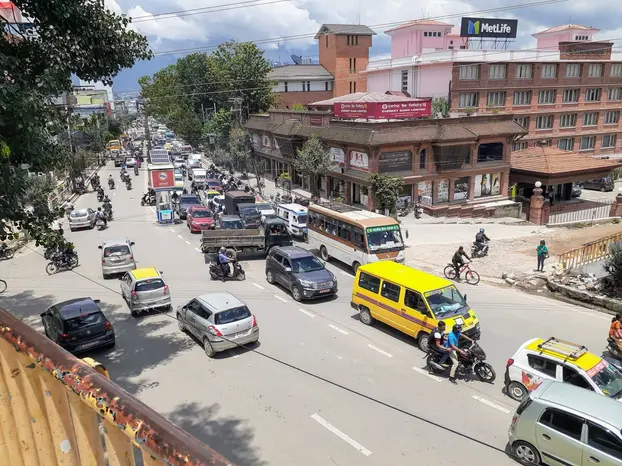
Kathmandu suffers from chronic congestion. Rush-hour traffic during commute and school times, congestion caused by illegal parking and stopping, incomplete traffic control by police officers who stand in for traffic lights, and even cows sitting in the road mean major jams are an everyday occurrence.
Traffic lights and crosswalks to ease congestion have become more common recently, but because there is no custom of learning traffic rules in school, everyone essentially experiences traffic rules for the first time in practice.
In Nepali common sense, on roads without traffic lights there is an unspoken rule that drivers and pedestrians work things out as they cross. There is no sudden acceleration, hard braking, or rushing across; crossing at a gentle pace is the rule that every Nepali practices.
Summary
In Nepal, where modernization lags, there are no automated systems to replace manpower, and not only transportation but many aspects of life still follow traditional methods. In a Nepal where old ways continue to play an active role, habits of relying on people and living freely remain in place of convenience and comfort. The human, down-to-earth character of Nepalis is likely a quality born from this less-than-convenient environment.
 Written by
Share this article


