CULTURE & LIVING ABROAD
Where Nepalese People Meet Death: The Hindu Temple Pashupatinath
When a Hindu Nepalese person dies overseas, the religious ideal is to repatriate the body from abroad to their home country of Nepal, cremate it at the Hindu temple Pashupatinath, and return the remains to the Bagmati River. That is considered the ideal way to meet death.
The number of Nepalese living or working abroad continues to rise year by year, and among them are unfortunate cases in which people die overseas due to working conditions or stress.
Support for Nepalese who meet an unfortunate end overseas can be obtained through diplomatic missions abroad, but whether the body can be repatriated depends on each individual’s circumstances.
For families waiting in Nepal, the death of a relative overseas and a form of death that does not align with religious practice can be deeply hard to accept.
What Is Pashupatinath?
Pashupatinath is Nepal’s largest Hindu temple and one of the four major Shiva temples on the Indian subcontinent.
Ascetics and pilgrims gather at Pashupatinath from India and across Nepal. Once a year, the festival honoring Lord Shiva, Maha Shivaratri, draws even larger crowds of pilgrims and becomes a particularly special day.
At Pashupatinath, ascetics known as sadhus, who practice meditation and austerities, can be seen throughout the grounds. Their appearance, together with the distinctive atmosphere of Pashupatinath, forms a powerful part of the scene.
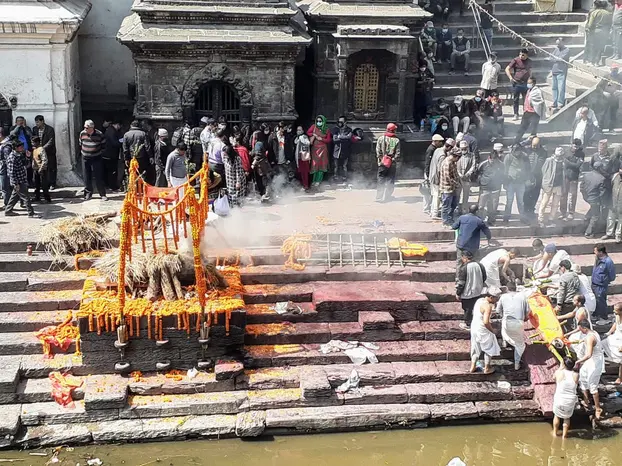
Pashupatinath includes the Pashupatinath Temple, which only Hindus may enter, and along the adjacent Bagmati River there are multiple cremation platforms. Bodies are brought one after another to these platforms, and the cremation process begins according to Hindu rites.
The body is wrapped in an orange cloth, the cremation platform is decorated with marigold flowers, and once the funeral pyre is lit, the cremation ceremony begins. The cremation can be observed by non-Hindu tourists as well, making it a place where visitors can experience Nepalese custom.
Open to Anyone: Witnessing the Moment a Person Is Cremated
When a Hindu Nepalese person dies, the bereaved family contacts those concerned and at the same time begins arranging cremation at Pashupatinath and preparing the funeral. Worshippers gathered at Pashupatinath spend the time of cremation bidding farewell to the deceased, and the rites proceed according to Hindu custom.
It is common for the remains to be cremated at Pashupatinath and the ashes scattered into the Bagmati River. Unlike Japanese graves, there is no place one “enters” after death.
The Bagmati River, into which the ashes flow, is connected to a tributary of India’s sacred Ganges River. Before cremation, the body is purified with this sacred water and then the pyre is lit.
On the Bagmati River float scattered marigold flowers and remnants of the orange cloth the deceased wore. Against the gray river carrying the ashes, their colors stand out vividly and leave a strong impression.
Whereas cremations in Japan take place entirely behind closed doors, cremations in Nepal are open even to unknown onlookers outside the family, who witness the entire process of a person being cremated.
Nepalese Views of Life and Death
Meeting death at Pashupatinath, a sacred site of Hinduism, is for Nepalese people an ideal and deeply meaningful end of life.
In the Hindu understanding, past, present, and future continue forever. When life ends, one is reborn again and again, turning like a wheel—that is said to be the course of a human life.
For Nepalese people who from childhood have repeatedly watched relatives disappear in flames on the cremation platforms of Pashupatinath, their way of facing death is clearly different from that of Japanese people.
Procedures when a foreign national dies in Japan
When a foreign resident dies of illness or in an accident, there are procedures from within Japan through to the diplomatic mission of their home country.
Flow of procedures after death
- 1 Submit a death notification to the municipal office where the resident record is registered.
- 2 The municipal office contacts the Legal Affairs Bureau. Notice is then conveyed from the Legal Affairs Bureau to the Ministry of Foreign Affairs.
- 3 The Legal Affairs Bureau contacts the Ministry of Foreign Affairs.
- 4 The death notification reaches the diplomatic mission of the home country and related offices via the Ministry of Foreign Affairs.
Points to note:
- Whether cremation is acceptable for religious reasons must be decided in consultation with the bereaved family.
- If the body is not cremated in Japan and is instead repatriated to the home country, embalming (preservation and disinfection of the body) and shipping costs will be required.
- Costs for body repatriation include air freight, transport, delivery, the coffin, various procedures, embalming, and related expenses.
- Procedures differ by country.
In Closing
Pashupatinath is regarded by Hindu Nepalese as an ideal place to meet the end of life.
Some Nepalese who die overseas meet an end that does not align with their religion. If your workplace has Nepalese employees, it may be helpful for managers to know a little about Pashupatinath.
 Written by
Share this article


